
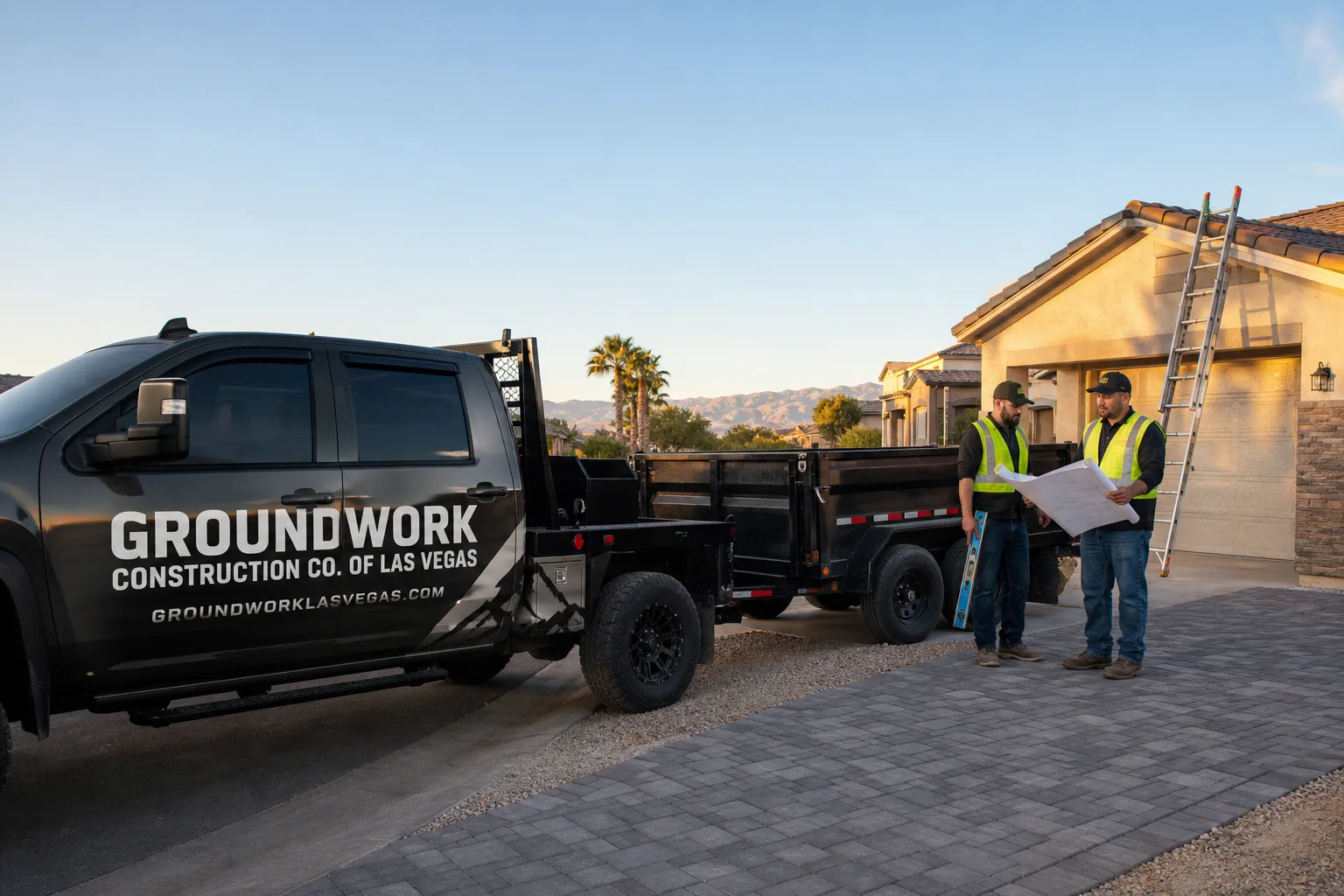
What Does ADU Site Prep & Utilities Cost and Involve in Spring Valley?
ADU Site Prep & Utilities in Spring Valley typically runs $45,000-$130,000 depending on whether you’re trenching through caliche hardpan, relocating existing sewer and electrical lines, or working around a post-tension slab. Most jobs take 3-6 weeks from mobilization to rough-in inspection, with the soil-breaking phase alone adding days that contractors from outside the Las Vegas Valley rarely account for. Call (855) 951-4361 and a live person will walk through your specific lot conditions.
How We Handle ADU Site Prep & Utilities, Start to Finish
We’ve learned that Spring Valley’s combination of caliche and post-tension slabs kills schedules when it’s treated as an afterthought. Here’s how we sequence the work to keep your Home Additions & ADU in Spring Valley project on track.
Stage 1: Utility locate and slab mapping (2-3 days)
Before any shovel hits dirt, we bring in ground-penetrating radar to map post-tension cables in the existing slab and call in private locates for any undocumented lines. Homeowners decide here whether to preserve the existing slab footprint or cut through it, which determines whether we need a structural engineer’s letter. This stage looks slow but prevents the catastrophic cable-cut scenario we’ve seen out-of-state crews walk into.
Stage 2: Caliche breaking and rough excavation (3-7 days)
Standard excavators bounce off Spring Valley’s calcium-carbonate hardpan. We bring pneumatic rock breakers or chain trenchers depending on trench depth and length. The caliche layer varies; we’ve hit it at 8 inches in some lots off Flamingo Road and at 30 inches near Spring Mountain Road. Homeowners choose whether to export excess spoils or use them for finished-grade backfill, which affects trucking costs.
Stage 3: Utility rough-in and trenching (5-10 days)
This is where sewer lateral extensions, water service upsizing, gas line reroutes, and electrical service upgrades happen. Spring Valley’s older 1970s-1980s tract homes often have 100-amp main panels and 3/4-inch water services, both undersized for a modern ADU. We coordinate with Southwest Gas and NV Energy for meter splits or upgrades. Homeowners pick fixture locations now; moving a toilet flange after this stage costs thousands.
Stage 4: Foundation prep and drainage (3-5 days)
We set compacted aggregate base, install perimeter drainage to handle those brief, intense monsoon downpours, and pour footings or slab-on-grade depending on your ADU design. Concrete gets scheduled for 5:00 a.m. pours in summer months to beat the 110°F flash-cure window. Homeowners approve the final grade and drainage direction here; we warranty the work, but we can’t warranty against water intrusion if grade drains toward the structure.
Stage 5: Rough-in inspection and site turnover (1-2 days)
Clark County inspects plumbing, electrical, and gas rough-ins before we backfill. We leave the site broom-clean and staged for your Home Additions & ADU framing crew. Our Spring Valley projects typically hit this milestone in 18-28 calendar days, though caliche depth and utility coordination can push the back end.
The Material and System Choices You’ll Face
ADU Site Prep & Utilities isn’t about picking granite colors, but the decisions here lock in performance and cost for decades. Here’s what we walk homeowners through:
- Water service line: copper Type L vs. PEX-A. Copper handles Spring Valley’s mineral-heavy municipal water and UV exposure if any section runs above grade, but it’s 40-60% more expensive and requires longer lead times. PEX-A is flexible for caliche trenching, faster to install, and carries a 25-year warranty, but we sleeve any exposed runs to prevent UV degradation.
- Sewer lateral: PVC Schedule 40 vs. ABS. Both pass code, but PVC’s joint strength matters in caliche trenches where ground movement is real. We default to PVC for anything below 4 feet and ABS only for interior drops. The cost difference is minimal; the call is really about whether your existing sewer has slope issues that need a grinder pump.
- Electrical service: overhead drop vs. underground. Spring Valley’s older neighborhoods have mixed overhead and underground utilities. Underground looks cleaner and survives our wind events, but trenching to the transformer adds $3,000-$8,000. Overhead is faster and cheaper unless NV Energy requires a service upgrade that forces underground conversion anyway.
- Drainage: French drain vs. surface swale vs. tied to municipal storm. French drains handle our intense monsoon bursts but need cleanout access and eventually clog with desert sediment. Surface swales are zero-maintenance but eat yard space. Tying to municipal storm is ideal where available, though many Spring Valley tracts predate storm sewer installation.
- Foundation type: stem wall on footings vs. monolithic slab. Stem walls cost more upfront but let us adjust for caliche irregularities without thickening the entire slab. Monolithic pours are faster and cheaper, but any heave or settlement cracks the whole floor. On caliche we almost always recommend stem walls; the exception is small garage conversions where the existing slab can be tied in.
What ADU Site Prep & Utilities Costs in Spring Valley, NV
| Component | Typical Range |
|---|---|
| Caliche breaking and excavation | $8,000 - $22,000 |
| Utility rough-in (water, sewer, gas, electric) | $15,000 - $45,000 |
| Foundation and drainage | $12,000 - $38,000 |
| Permits, inspections, utility coordination | $4,000 - $12,000 |
| Site restoration and finish grading | $3,000 - $8,000 |
| Total ADU Site Prep & Utilities | $45,000 - $130,000 |
Five factors push you to the high or low end of that range:
- Caliche depth and extent. Shallow, patchy caliche breaks fast. A continuous 3-foot layer across the entire build footprint requires rock-saw trenching and adds a week.
- Existing utility capacity. A 200-amp panel and 1-inch water service means simple tie-ins. Upgrading from 100-amp and 3/4-inch service triggers utility company work and longer timelines.
- Slab penetration complexity. Preserving the existing slab is cheapest. Cutting for plumbing drops or structural ties requires GPR mapping, engineered cable avoidance, and post-tension repair, adding $2,000-$6,000.
- Distance to tie-in points. An ADU at the rear of a deep Spring Valley lot means longer trench runs. We’ve done 80-foot sewer laterals and 150-foot electrical trenches; both scale linearly.
- Drainage requirements. Flat lots or those with poor percolation need engineered drainage systems. Sloped lots with natural drainage are simpler and cheaper.
Our written estimates include all labor, materials, permits, and the 730-Day Done Right Promise. What’s typically separate: utility company fees for meter upgrades, dewatering if we hit perched water (rare but real in pockets near Flamingo Road), and any required soil engineering reports. Upfront pricing, no surprises.
Why Spring Valley Homes Make This Job Different
The housing stock here shapes everything. Spring Valley’s stucco-clad wood-frame tracts from the 1970s through 1990s sit on post-tension slabs that were engineered for the original footprint, not an addition. We’ve mapped cables in slabs off Spring Mountain Road where the tensioning pattern was irregular, and in others near Flamingo where the original builder used a different cable spacing than the plans showed. That variance is why we GPR every cut, every time.
The caliche hardpan isn’t just hard; it’s unpredictable. We’ve hit layers that shattered under a pneumatic breaker in two hours, and others that ate a full day for a ten-foot trench. Contractors trained in Midwest or East Coast soils bid these jobs wrong because they’ve never seen excavation equipment stall on what looks like ordinary dirt.
Then there’s the thermal cycling. Our 110°F summers and near-freezing winter nights stress sealants, expansion joints, and waterproofing membranes on a timeline that most national product specs don’t account for. We specify materials rated for desert exposure, not just “exterior grade,” because the UV degradation here is real and expensive to fix later. And those monsoon downpours? They’ll find any drainage shortcut you took. We grade for the hundred-year burst, not the average rainfall.
Many homeowners doing ADU Site Prep & Utilities in Spring Valley also update their main home’s kitchen or bathroom while crews are mobilized. If you’re considering that, see our Small & Partial Kitchen Remodels in Spring Valley or Full Bathroom Remodeling in Spring Valley - we can coordinate trades and save on mobilization costs.
Serving Spring Valley, NV - Our Local Coverage Area
We’re based in the Spring Valley area and know this community well. Use the map below to see our service coverage - if you’re nearby, we can almost certainly help.
Frequently Asked - ADU Site Prep & Utilities in Spring Valley
Most jobs finish in 3-6 weeks, with caliche breaking and utility coordination eating the most calendar time. We’ve completed simple lots with shallow soil in 16 working days, and complex jobs with full service upgrades in 8 weeks. Call (855) 951-4361 for a timeline based on your lot’s conditions.
Yes, Clark County requires permits for excavation, utility work, and foundation placement, with separate rough-in inspections for plumbing, electrical, and gas. We pull permits as part of every job and schedule inspections to avoid rework. The permit timeline is typically 2-3 weeks for approval, which we run parallel to utility locate work.
Sometimes, if your ADU design keeps all utilities in the new footprint and the existing slab is preserved entirely. Most Spring Valley ADUs tie into the main home’s sewer and water, which requires at least one slab penetration. We engineer every cut to avoid post-tension cables; skipping that step to save money risks structural failure.
The lowest-cost path is tying into existing oversized service lines without upgrading the main panel or water meter, and keeping trench runs short. That scenario runs toward the $45,000 end of our range. The expensive triggers are 100-amp electrical upgrades, long sewer laterals, deep caliche, and any post-tension slab work. We price every option so you can decide where to spend.
Our 730-Day Done Right Promise covers all workmanship, including drainage performance, foundation integrity, and utility connections. If it’s not done right, we make it right. Material warranties run longer, from 25 years on PEX-A to 50 years on PVC drain lines, but our labor guarantee is one of the longest in residential construction. Built to last, backed in writing.
Get Your Free On-Site Estimate for ADU Site Prep & Utilities in Spring Valley
Call (855) 951-4361 anytime, day or night - a live person answers, never voicemail. We’ll schedule a site visit to map your slab, assess caliche depth, and deliver a written estimate with real numbers for your specific lot. From foundation to finish line, Groundwork Construction Co. handles the prep so your ADU build starts on solid ground.
Written by Todd Mervyn, Owner at Groundwork Construction Co., serving Spring Valley since 2014.