
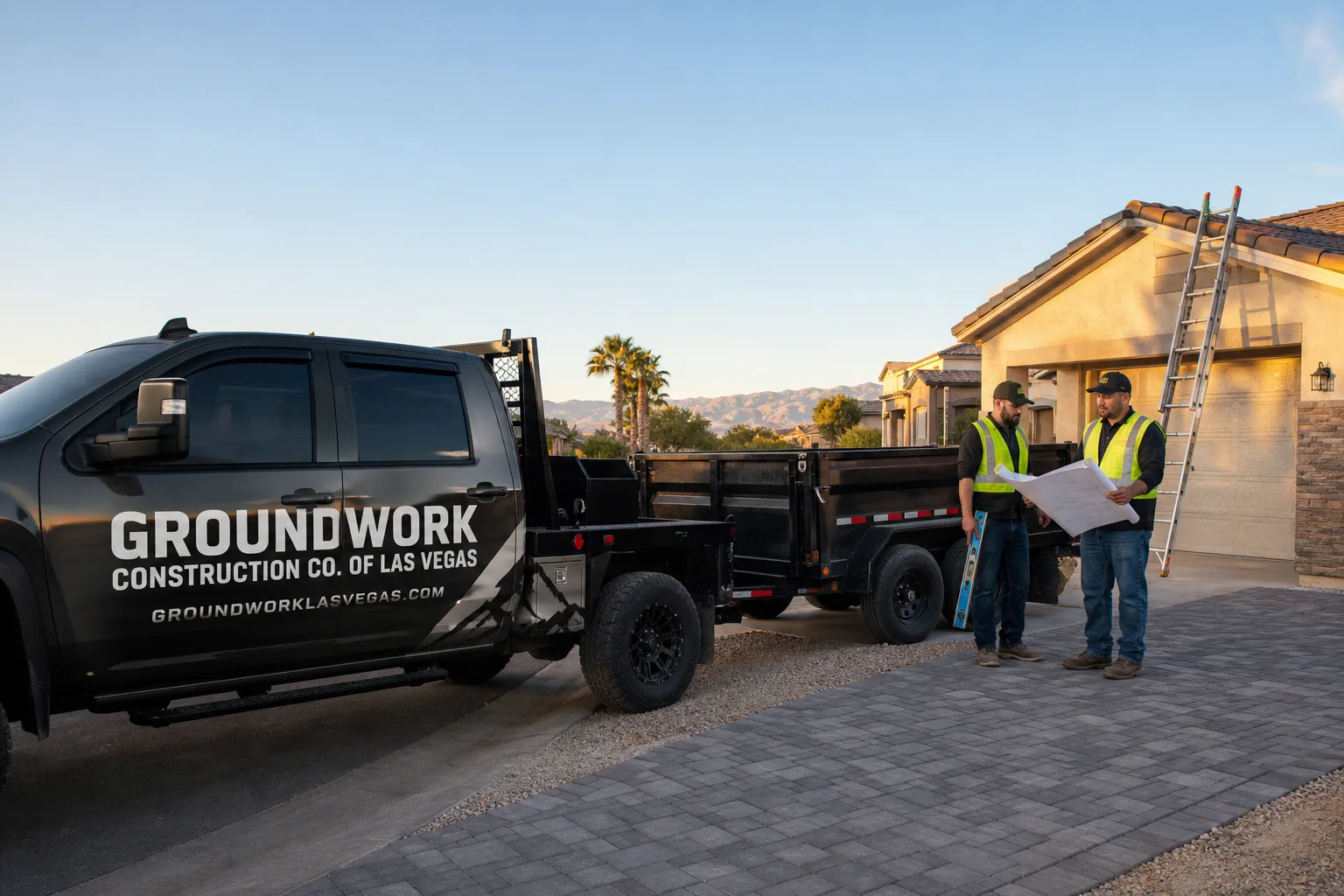
How Much Do Paver Driveways Cost in Boulder City, and How Long Do They Take?
Paver driveway installation in Boulder City typically runs $7,000-$18,000 for a standard two-car residential driveway, with most projects completed in 4-7 business days from permit approval to final compaction. We handle the full sequence: demolition of existing pavement, base preparation, edge restraint installation, paver laying, and polymeric sand finishing. Call (855) 951-4361 for a free on-site estimate - we answer live, 24/7.
The Way We Build Paver Driveways in Boulder City
Every paver driveway we install follows the same five-stage sequence we’ve refined across hundreds of jobs in Clark County. Here’s what actually happens, and what you’ll need to decide at each point.
Stage 1: Site evaluation and layout confirmation (Day 1)
We arrive with laser levels and grade stakes to confirm drainage slope - non-negotiable in Boulder City, where a single summer monsoon can funnel water straight toward your foundation if the pitch is wrong. You’ll decide the exact footprint: whether to widen for guest parking, curve around existing landscaping, or maintain a straight run. We mark utility locations and photograph the existing driveway condition for our records. This stage takes 2-3 hours.
Stage 2: Demolition and excavation (Days 1-2)
We break out existing concrete, asphalt, or old pavers and haul to a licensed recycling facility - never dumped illegally on Bureau of Reclamation land, which we’ve seen out-of-town crews attempt near the Lake Mead boundary. Excavation depth runs 8-12 inches depending on soil stability and expected vehicle load. Boulder City’s decomposed granite soils drain well but shift under heavy point loads, so we often go deeper on driveways that’ll see RV or boat parking. You’ll confirm whether we’re matching existing grade or correcting a slope problem you’ve been fighting.
Stage 3: Base installation and compaction (Days 2-3)
This is where driveways fail or last 25 years. We lay geotextile fabric, then import crushed aggregate base in 4-inch lifts, compacting each layer with a plate compactor to 95% standard Proctor density. We test with a nuclear density gauge on larger jobs. Boulder City’s freeze-thaw cycles are mild, but the daily 40°F summer temperature swings still stress inadequately compacted bases. You’ll choose whether to upgrade to a cement-stabilized base for heavy loads - adds roughly $800-$1,400 but eliminates settling on soft spots.
Stage 4: Paver installation and cutting (Days 3-5)
We set edge restraints on a concrete haunch, screed bedding sand to 1-inch depth, and lay pavers in your chosen pattern. Soldier courses and border cuts happen here - the slow, precise work that separates professional results from weekend-warrior gaps. We pull and relay any paver that doesn’t sit flush; tolerance is 1/8-inch across the field. You’ll do a walkthrough before we sand the joints, since pattern adjustments are nearly impossible after locking.
Stage 5: Joint stabilization and final compaction (Day 5-6)
We sweep polymeric sand into joints, vibrate with a rubber-mat compactor, and activate with a controlled water mist. This creates the interlock that transfers loads across multiple pavers instead of concentrating on individual units. We seal expansion joints against the garage slab and street apron, then roll the surface with a plate compactor one final time. You’re back in business by evening - no cure time like concrete.
Permitting in Boulder City adds 5-15 business days to the front end, which we’ll explain in the local section below. The construction itself rarely stretches past a week.
The Paver Choices That Actually Change Your Driveway
These are the real decisions you’ll make, with the trade-offs we see homeowners wrestle with most often:
- Concrete pavers vs. clay brick: Concrete dominates Boulder City installations - $4-$8 per square foot installed, available in tumbled, smooth, or slate-embossed finishes. Clay brick runs $8-$14 per square foot and carries richer color through the body, but the sharp edges chip under tire chains or heavy equipment. For standard residential use, concrete’s cost advantage is decisive.
- Thickness - 60mm vs. 80mm: 60mm pavers handle passenger vehicles fine and cost less. 80mm is the right call for RV pads, work trucks, or any driveway that’ll see occasional heavy delivery vehicles. The upgrade adds roughly $1.20-$1.80 per square foot but prevents the “dish” pattern that develops under point loads.
- Color and finish strategy: Light-toned pavers reflect Boulder City’s brutal UV and stay walkable barefoot in July; dark charcoal or terra cotta absorb heat and can hit 140°F surface temperature. Tumbled finishes hide dust and minor staining from our desert winds; smooth finishes look crisp for six months, then every tire mark shows.
- Pattern complexity: Running bond installs fastest and costs least. Herringbone and basketweave require 15-25% more cutting and labor but lock together more effectively under turning loads. We recommend herringbone for driveways with steep grades or tight turning radii.
- Permeable vs. standard installation: Permeable pavers with open-graded base allow water infiltration and can reduce runoff requirements, but they cost 20-30% more and need vacuum sweeping twice yearly to prevent joint clogging from our fine desert dust. Standard installation with positive drainage is the practical choice for most Boulder City homes.
We source through Belgard and other verified partners, so you’re selecting from production runs with consistent dye lots - not leftover warehouse bundles with color variation.
What Paver Driveways Cost in Boulder City, NV
Paver driveway installation in Boulder City ranges from $7,000 to $18,000 based on the variables below. Here’s what moves you through that range:
| Cost Driver | Low-End Scenario | High-End Scenario |
|---|---|---|
| Driveway size | 400 sq ft (single car) | 800+ sq ft (double with apron) |
| Existing condition | Gravel or thin asphalt, minimal demo | Thick concrete with rebar, utility relocation |
| Material grade | Standard 60mm concrete paver | 80mm premium with border accents |
| Site access and slope | Flat, open front yard | Steep grade, retaining wall needed, tight gate access |
| Permit complexity | Standard residential driveway | Historic district design review or federal easement coordination |
A typical 600-square-foot double driveway with standard 60mm pavers, moderate demo, and straightforward permitting lands around $10,500-$13,500.
What’s included in our written estimate: all demolition and hauling, base material and compaction, pavers and edge restraints, cutting and pattern labor, polymeric sand, final compaction, and jobsite cleanup. What’s typically separate: permit fees paid directly to the city, tree or stump removal, utility line relocation if your existing service runs through the driveway footprint, and any retaining wall or drainage system beyond the pavement itself. We flag these items during evaluation so you’re not surprised.
Our upfront pricing means the number on your proposal is the number you pay. We also offer 0% financing for 18 months and $1,000 off projects over $10,000, which most paver driveway jobs qualify for.
What Boulder City Specifically Does to This Job
Boulder City isn’t Henderson, and it isn’t Las Vegas - and the differences matter for your driveway timeline and budget.
The city’s legally enforced 1% annual residential growth cap means construction permits are rationed by ordinance, not just processed in order. Your paver driveway permit enters a queue that simply doesn’t exist in neighboring cities. We’ve navigated this system since 2014, and we know which applications move fastest: straightforward replacements on existing footprints with no expansion or drainage changes. If you’re widening toward the property line or altering the curb cut, expect additional review cycles. Out-of-town contractors who don’t know this rhythm often promise start dates they can’t meet.
The historic core around Nevada Way and the original government housing district triggers design review for any visible exterior work. We’ve replaced driveways on 1930s Mission Revival homes where the city required permeable materials or color palettes sympathetic to the original federal construction. That’s not a delay if you plan for it - it’s a disaster if your contractor discovers it mid-project.
Climate reality: Boulder City sits at roughly 2,500 feet with UV intensity that destroys standard exterior sealants in half their rated lifespan. We specify flexible, UV-stable joint sands and recommend re-sanding every 3-4 years instead of the 5-7 typical in milder climates. The daily temperature swing from 110°F afternoons to 70°F evenings stresses rigid materials; our base prep accounts for thermal expansion that Vegas contractors rarely consider.
Near the city’s edges, particularly toward Lake Mead Boulevard or any property backing Bureau of Reclamation land, federal easement review may be required. We’ve seen projects stall six months because a contractor didn’t identify this layer early. We check parcel maps before we quote.
Many homeowners pair a new paver driveway with larger property improvements. If you’re considering an accessory dwelling unit, our ADU Design & Permitting in Boulder City team coordinates the same permitting relationships, and our Garage Conversion ADU in Boulder City crew often sequences driveway work to match new garage footprints. For the full scope of hardscaping options, see our Driveway & Pavers in Boulder City overview, or explore our Driveway & Pavers service hub for regional project galleries. We cover all of Boulder City including the 89005 and 89006 ZIP codes, from the historic district to the newer developments near Boulder City Parkway.
Serving Boulder City, NV - Our Local Coverage Area
We’re based in the Boulder City area and know this community well. Use the map below to see our service coverage - if you’re nearby, we can almost certainly help.
Frequently Asked - Paver Driveways in Boulder City
Construction itself takes 4-7 business days once permits are in hand. Total elapsed time including Boulder City’s permit queue is typically 3-5 weeks. Call (855) 951-4361 and we’ll check current permit turnaround times for your specific project type.
Yes - any driveway replacement or new installation requires a city permit, and historic district properties need additional design review. We handle the application, site plans, and inspection scheduling as part of our standard process. The permit fee is paid directly to the city and is not included in our construction estimate.
Often yes, if utilities run at proper depth beneath the base layer. During evaluation, we locate and mark all buried lines. Shallow conduits or aging galvanized water lines may need relocation - we’ll show you exactly what’s down there before you commit, so you’re not facing a surprise change order mid-project.
Asphalt driveway paving runs $3,500-$9,000 versus $7,000-$18,000 for pavers, so asphalt costs less upfront. Pavers last 25-30 years with periodic joint maintenance; asphalt typically needs resurfacing in 12-15 years in our UV intensity. Over a 30-year horizon, the costs converge, and pavers add measurable curb appeal for resale in Boulder City’s competitive housing market.
Our 730-Day Done Right Promise covers workmanship - if settling, edge failure, or drainage issues develop from our installation, we return and make it right. Manufacturer defects in the pavers themselves carry separate material warranties. We document base compaction readings and drainage slopes so any future claim has clear benchmarks.
Get Your Free On-Site Estimate for Paver Driveways in Boulder City
Call (855) 951-4361 now - a live person answers 24/7, no voicemail. We’ll schedule a 45-minute evaluation at your Boulder City property, confirm utility locations and drainage requirements, and deliver a written estimate with upfront pricing within 24 hours. Most paver driveway projects book within two weeks of proposal acceptance. Built to last, backed in writing.
Written by Todd Mervyn, Owner at Groundwork Construction Co., serving Boulder City since 2014.