
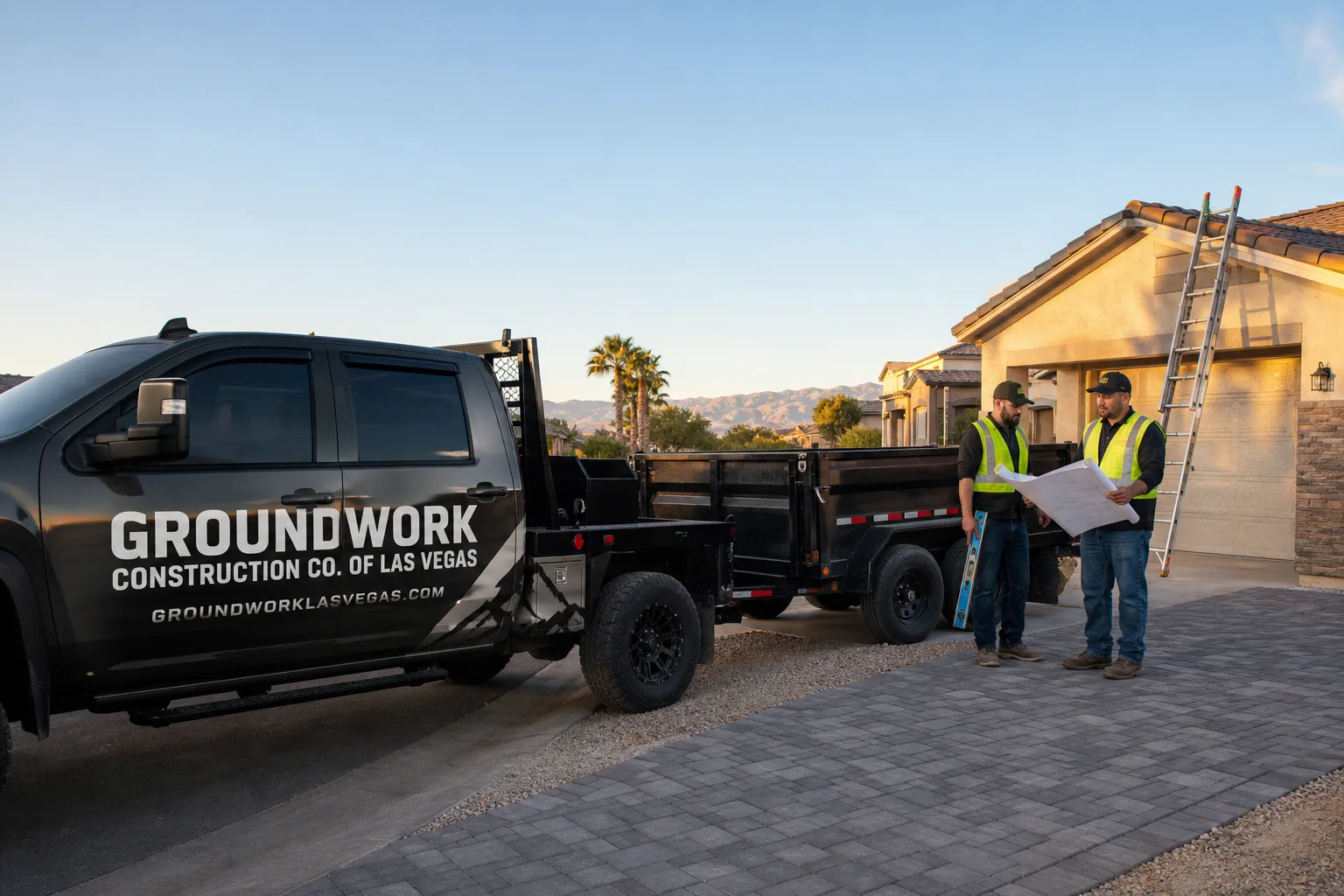
ADU Site Prep & Utilities in Boulder City, NV - What’s Involved, Timeline, and Cost
ADU Site Prep & Utilities in Boulder City covers the full ground-up preparation for an accessory dwelling unit: clearing and grading the build site, trenching for sewer and water lines from the main residence, running electrical service and gas if needed, and pouring the foundation or pad. Most Boulder City jobs we handle take 3 to 6 weeks from breaking ground to passing rough utility inspection, though the city’s unique permit allocation queue can add buffer time upfront. Budget $45,000-$130,000 depending on site conditions and utility complexity; call (855) 951-4361 and we’ll walk your property with you.
How we handle ADU Site Prep & Utilities from dirt to rough-in
Every ADU Site Prep & Utilities job in Boulder City follows a five-stage sequence. We’ve refined this over eleven years and hundreds of Las Vegas Valley projects, but Boulder City’s growth cap and historic districts mean we build extra coordination into the front end.
Stage 1: Site survey and utility locate (2-3 days). Before a shovel hits dirt, we pull existing utility maps from the city and NV Energy, then hand-verify with private locates. Boulder City’s older neighborhoods, especially around the historic core, have decades of homeowner-added lines that never made it onto official drawings. We mark everything: your domestic water, sewer lateral, electrical service, gas, and any irrigation you want preserved. You’ll decide at this stage whether to keep the ADU on the existing meter set or request a separate service address, which affects trenching depth and permit path.
Stage 2: Demolition and rough grade (3-5 days). If we’re building on a former driveway, patio, or yard space, this means breaking out concrete or asphalt, hauling off debris, and cutting down to stable subgrade. Boulder City’s caliche layer can sit anywhere from 8 inches to 3 feet below surface; we probe with a backhoe to find it. You choose here whether to export all fill or reuse suitable material as engineered fill for the pad, which saves haul costs but requires compaction testing.
Stage 3: Utility rough-in and trenching (5-10 days). This is where the real work happens. We trench from main to ADU location: sewer line typically 4-inch ABS or PVC at 1/4-inch per foot minimum slope, water in PEX or copper depending on your preference and Boulder City’s water pressure (which runs higher than Las Vegas proper due to elevation). Electrical conduit goes in separate trench at required separation. Gas, if you’re heating or cooking with it, gets its own run from the meter. You’ll need to decide tankless vs. tank water heater location now, as it affects venting and gas line sizing. We schedule the city rough-in inspection once everything’s pressure-tested and before backfill.
Stage 4: Foundation or pad prep (3-7 days). For slab-on-grade ADUs, we form and pour a monolithic slab with thickened edge beams; for stem-wall construction, we pour footings first, then block or pour walls. Boulder City’s expansive clay pockets in the 89006 area sometimes require engineered post-tension slabs or pier foundations, which we’ll flag during survey. You pick your floor system here: slab, raised wood, or insulated concrete forms. Each changes your thermal performance and your final finish height relative to grade.
Stage 5: Final grade and site restoration (2-3 days). After final inspection, we backfill trenches, compact in lifts, and restore your yard to a clean, buildable state. We leave the site ready for framing crews. Most of our Boulder City ADU Site Prep & Utilities jobs hand off to the builder at this point, though we’re also happy to stay on as part of a full Home Additions & ADU in Boulder City project.
The build choices that actually change your ADU Site Prep & Utilities outcome
- Separate electrical service vs. subpanel tap. A new meter and service from NV Energy runs $4,000-$8,000 more but gives the ADU independent billing and full amperage. Tapping the main house panel is cheaper and faster, but you’re limited by existing capacity and the ADU shares the bill. For rental ADUs in Boulder City, most homeowners go separate; for family use, the subpanel often wins.
- Sewer gravity line vs. grinder pump system. If your ADU sits below the main sewer lateral elevation, a grinder pump station adds $3,500-$6,500 but eliminates regrading the entire yard. In Boulder City’s hillside lots near the Lake Mead overlook areas, this comes up regularly. Gravity is simpler and cheaper long-term, but only works when slope cooperates.
- Standard concrete slab vs. insulated slab or raised floor. A basic 4-inch slab with edge insulation meets code; upgrading to a fully insulated slab with radiant tubing rough-in adds $6-$10 per square foot but pays back in Mojave Desert heating costs. Raised wood floors with crawl space ventilation work better on sloped Boulder City lots but need moisture barriers and careful pest detailing.
- Gas service extension vs. all-electric build. Southwest Gas line extensions run $15-$25 per linear foot from the main, plus a service upgrade if your meter’s undersized. All-electric avoids this but may require a 200-amp or larger service. Boulder City’s 110°F summers make heat-pump water heater placement critical; we spec shaded exterior locations or garage installs to keep efficiency up.
- Trench and backfill method. Open trench with backhoe is standard. Directional boring under existing hardscape adds 40-60% but preserves your driveway, patio, or mature landscaping. In Boulder City’s established neighborhoods where homeowners have invested in desert-scaped yards, boring often saves money net of restoration.
What ADU Site Prep & Utilities costs in Boulder City, NV
| Component | Typical Range |
|---|---|
| Basic ADU Site Prep & Utilities (flat site, existing services) | $45,000-$75,000 |
| Moderate complexity (slope, longer utility runs, some rock) | $75,000-$105,000 |
| High complexity (hillside, separate services, extensive demo, caliche) | $105,000-$130,000 |
Five factors push you toward the high or low end of ADU Site Prep & Utilities pricing in Boulder City. First, site slope and access: a backyard ADU with alley or side-yard equipment access costs less than one requiring crane or mini-excavator work between structures. Second, utility distance: every extra ten feet of trench adds material and labor; we’ve done Boulder City jobs where the sewer lateral was 80 feet from the build site versus 25 feet, and that gap alone moved the number $8,000. Third, existing conditions: breaking out an old swimming pool or dealing with undocumented fill from 1960s construction adds demo and testing costs. Fourth, material and system grade: copper water lines, insulated slabs, and separate electrical service all add upfront cost but reduce lifetime operating expense. Fifth, permit and inspection scope: Boulder City’s 1% annual growth cap means permit allocation queue timing, and any project near federal land may trigger Bureau of Reclamation easement review, adding weeks and professional survey costs.
Our written estimates include all labor, materials, equipment, permits, and inspections for the scope described. What typically sits outside: landscaping restoration beyond basic grading and seeding, separate architectural or engineering stamps if your ADU design requires them, and any utility company service upgrade fees charged directly by NV Energy or Southwest Gas. Upfront pricing, no surprises - the number you see is the number you pay.
Why Boulder City itself changes how we approach this job
Boulder City isn’t Henderson. It isn’t Las Vegas. And anyone who treats it like either is going to lose months to permitting surprises.
The growth cap is the big one. Boulder City is one of the only incorporated cities in the United States with a legally enforced residential growth cap, roughly 1% annual growth, meaning construction permits for new homes are rationed by ordinance, not just demand. Contractors here must navigate a permit allocation queue that simply does not exist in neighboring Henderson or Las Vegas. For ADU Site Prep & Utilities, this means we file early, we file complete, and we maintain relationships with Boulder City planning staff who can flag issues before they become rejections. An out-of-town crew who shows up with standard Clark County paperwork gets sent back to start over.
The housing stock matters too. In the historic core around Nevada Way and the original 1930s Mission Revival homes built for Hoover Dam workers, we regularly encounter aging concrete block construction and original lime plaster that can’t take modern Portland cement stucco without trapping moisture. Any ADU Site Prep & Utilities job adjacent to these properties triggers historic district design review, even for a backyard structure, and requires period-appropriate material matching. We’ve walked properties where the sewer lateral was terracotta from the 1940s and still functional, and others where it had collapsed under a century of caliche pressure.
Beyond the historic district, the mid-century and 1960s-70s ranch homes that dominate 89005 and 89006 often sit on lots with minimal setbacks and shallow utilities. The Mojave Desert climate at 2,500 feet elevation hits harder here than in Las Vegas proper: UV radiation that destroys exterior sealants in half their rated life, and humidity below 10% that splits wood framing if we don’t specify moisture-stabilized lumber and flexible sealants on every exterior penetration. We build these conditions into our material specs from day one, not as change orders after the fact.
And then there’s the federal overlay. Because so much land surrounding Boulder City is controlled by the Bureau of Reclamation and the National Park Service (Lake Mead NRA), any construction project near the city’s edges may require federal easement review or coordination with Reclamation. We’ve seen out-of-town contractors stall jobs for months because they didn’t know to check the Reclamation boundary map before staking the site. We check it in stage one, every time.
Common local scenarios we see on Boulder City ADU Site Prep & Utilities jobs
The historic district backyard cottage. Homeowner on Utah Street wants a 400-square-foot ADU for aging parents. We hit terracotta sewer, have to sleeve it with PVC, and the design review board wants stucco color match to the 1937 main house. Utility runs are short but coordination is long.
The hillside Lake Mead view lot. Great views, but the ADU pad sits 8 feet below the sewer lateral. Grinder pump or regrade? We walk the math with the homeowner, factoring in how Boulder City’s higher water pressure affects head calculations.
The 1970s ranch with a pool nobody wants. Demo the pool, backfill with engineered material, test compaction, and suddenly the ADU pad is where the deep end was. These jobs always find something unexpected in the excavation; we build 10% contingency into our estimates and tell homeowners why upfront.
The “we want to rent it” separate-meter job. Most common call we get. Requires NV Energy service extension, separate water tap (if Boulder City water authority approves), and sometimes a separate address from the post office. We handle the utility coordination so you don’t spend your Saturdays on hold.
Homeowners often pair ADU work with interior updates to the main house. If you’re already trenching utilities and living through construction, it’s efficient to coordinate Small & Partial Kitchen Remodels in Boulder City or Full Bathroom Remodeling in Boulder City on the same timeline. Our Home Additions & ADU crew can scope both.
Serving Boulder City, NV - Our Local Coverage Area
We’re based in the Boulder City area and know this community well. Use the map below to see our service coverage - if you’re nearby, we can almost certainly help.
Frequently asked - ADU Site Prep & Utilities in Boulder City
Most jobs run 3 to 6 weeks of active construction after permits release. Boulder City’s permit allocation queue can add 2 to 8 weeks before we break ground, which is why we file immediately upon contract and maintain open communication with planning staff. Call (855) 951-4361 and we’ll check current queue timing for your specific project type.
In Boulder City, utility rough-in and foundation work are typically covered under the master ADU building permit, but separate plumbing and electrical permits may be required depending on scope. We handle all permit packaging as part of our service. The growth cap permit allocation applies to the master permit, so getting that filed correctly and completely is critical to avoiding queue delays.
Sometimes, if the ADU location falls within the existing service lateral’s capacity and slope requirements. More often in Boulder City’s older neighborhoods, we need to extend or replace portions of the line due to age, capacity, or routing. We camera-inspect existing lines during our site survey and give you a straight answer before pricing, not after we’ve started digging.
The lowest-cost path is a flat site with short utility runs, shared electrical service, gravity sewer, and standard concrete slab. That typically lands in the $45,000-$60,000 range. Every variable that complicates site conditions pushes the number up. We don’t quote low to get the job and change-order you later; our upfront pricing includes realistic contingencies for what we actually find on your property.
All Groundwork Construction Co. work is backed by our 730-Day Done Right Promise - if it’s not done right, we make it right. That covers workmanship on utility connections, foundation, and site prep. Manufacturer warranties apply to specific materials like pipe, conduit, or water heater units. We’re also insured and bonded, and every technician on your Boulder City job is background-checked and uniformed.
Get your Boulder City property evaluated for ADU Site Prep & Utilities
Call (855) 951-4361 and a live person will answer, 24/7. We’ll schedule a free on-site estimate in Boulder City, walk your property with you, flag the utility routing and site constraints we can see, and deliver a written, itemized proposal with upfront pricing, no surprises. Most estimates are completed within 48 hours of the site visit, and we can coordinate with your architect or ADU builder if you’re already in design.
Written by Todd Mervyn, Owner at Groundwork Construction Co., serving Boulder City and the Las Vegas Valley since 2014.