
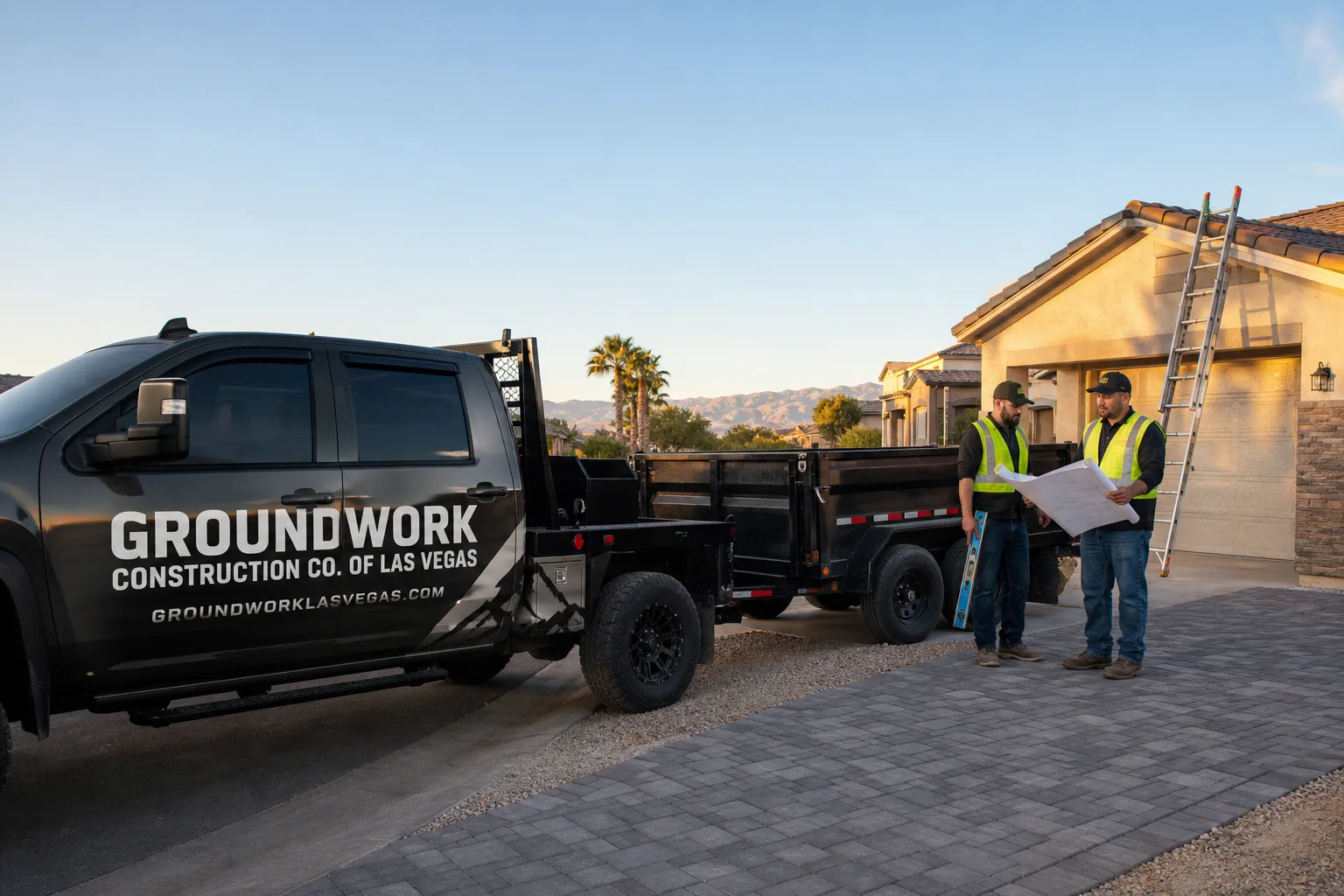
How Much Does Asphalt Driveways & Resurfacing Cost in Spring Valley, NV?
Asphalt driveway paving in Spring Valley runs $3,500-$9,000 for a typical residential install, while resurfacing an existing asphalt surface usually falls between $2,000-$5,500 depending on square footage and base condition. Most jobs take 2-4 days from removal to final roll, and we can start with a free on-site estimate when you call (855) 951-4361. Groundwork Construction Co. has handled asphalt work in Spring Valley’s older subdivisions since 2014, so we know what the caliche soil and decades of desert heat do to these surfaces.
How We Handle Asphalt Driveways & Resurfacing From Start to Finish
Every asphalt job in Spring Valley follows a five-stage sequence. Here’s what happens, how long each stage takes, and what you’ll need to decide.
Stage 1: Site evaluation and utility clear (Day 1, 2-3 hours)
We walk the existing surface with you, measure exact square footage, and check for buried irrigation, electrical runs, or gas lines that cross the driveway path. In Spring Valley’s 1970s-1990s neighborhoods, we also flag whether your home sits on a post-tension slab; if the driveway connects to a garage slab or covered carport, we bring cable-locating equipment to avoid cutting tension cables during edge prep. You’ll decide at this stage whether to expand the driveway footprint, add parking pad space, or keep the original dimensions.
Stage 2: Removal and base excavation (Days 1-2, 6-10 hours)
Old asphalt comes out with a skid-steer or mini-excavator. Here’s where Spring Valley’s caliche hardpan shows itself. Standard digging rarely gets deep enough for proper base drainage; we often need pneumatic breakers or rock saws to cut through that calcium-carbonate layer and achieve the 6-8 inch aggregate base depth that asphalt needs to last. If we hit caliche, the timeline extends by half a day. You’ll see the exposed base and approve any depth adjustments before we proceed.
Stage 3: Grading, drainage, and compaction (Day 2, 4-6 hours)
We grade for slope, typically 1-2% away from structures, and install any needed French drains or channel drains where Spring Valley’s brief but intense monsoon rains collect. The aggregate base gets laid in lifts and compacted with a vibratory roller. You’ll confirm drain placement and whether you want edging (steel, concrete curb, or paver border) to contain the asphalt long-term.
Stage 4: Asphalt placement and compaction (Day 3, 3-5 hours)
Hot-mix asphalt arrives at 275-300°F. In summer, we schedule this stage for early morning, before Spring Valley temperatures climb past 100°F and risk surface cooling too fast or flash-curing the top layer. We lay in two lifts for driveways over 2,500 square feet, compact between each, and finish with a smooth drum roll. You’ll do a walkthrough before the surface cools to catch any texture concerns.
Stage 5: Curing and sealant scheduling (Days 4-14)
The surface cures for 3-5 days before vehicle traffic. We schedule your first seal-coat application for 6-12 months out, after the asphalt has fully oxidized and hardened. In Spring Valley’s UV-intense climate, that first seal coat is critical; without it, oxidation accelerates and you’ll see surface raveling within two years.
The Material and Spec Choices You’ll Actually Decide On
Asphalt Driveways & Resurfacing isn’t one-size-fits-all. Here are the real options we present Spring Valley homeowners, with the honest trade-offs:
- Standard hot-mix vs. polymer-modified asphalt: Standard mix costs less upfront and performs adequately for typical residential traffic. Polymer-modified adds rubberized compounds that flex better under thermal expansion, which matters in Spring Valley where daily temperature swings of 40°F stress rigid surfaces. Polymer runs 15-25% higher but extends service life by 3-5 years in desert conditions.
- 2-inch vs. 3-inch compacted thickness: Two inches handles passenger vehicles on a stable base. Three inches is worth the upgrade if you park heavy trucks, RVs, or if your base has any history of settling. The cost difference is roughly $0.80-$1.20 per square foot.
- Recycled asphalt (RAP) content: Higher RAP percentages lower material cost and environmental impact, but excessive recycled content reduces binding strength. We specify 15-20% RAP for Spring Valley residential jobs, a balance that holds up under summer heat without the brittleness of high-recycle mixes.
- Seal-coat type: Coal-tar-based sealers resist UV longest but have higher VOC content. Asphalt-emulsion sealers are lower-odor and more environmentally friendly, though they require reapplication every 2-3 years instead of 3-4 in Spring Valley’s sun exposure. We default to asphalt-emulsion for homes with children or pets who contact the surface regularly.
- Edge treatment: Uncut edges feather into landscape and cost nothing extra. Concrete ribbon curbs or paver borders contain the asphalt, prevent edge cracking, and define the driveway visually. Paver borders pair naturally with a wider Driveway & Pavers in Spring Valley project if you’re updating the whole approach.
What Asphalt Driveways & Resurfacing Costs in Spring Valley, NV
| Job Type | Typical Range | Covers |
|---|---|---|
| New asphalt driveway (standard residential) | $3,500-$9,000 | Removal, base prep, 2″-3″ asphalt, compaction |
| Asphalt resurfacing (overlay) | $2,000-$5,500 | Milling or cleaning, tack coat, 1.5″-2″ new layer |
| Driveway extension or parking pad | $1,500-$4,000 | Additional base and asphalt, tied to existing edge |
| Base repair + resurfacing (failed subgrade) | $4,500-$8,500 | Partial excavation, new aggregate base, full asphalt layer |
Five variables push your job to the low or high end of these ranges. Size and shape matter most: a simple rectangle costs less per square foot than a curved or stepped driveway that requires hand work and multiple cuts. Existing surface condition determines whether we can overlay or must remove; alligator cracking, potholes, or base failure means full removal. Caliche depth varies block by block in Spring Valley; shallow caliche adds a few hours, deep or continuous layers add equipment and labor. Material grade - standard vs. polymer-modified - shifts cost 15-25%. Drainage complexity adds expense if we need to install channel drains, connect to existing storm systems, or regrade swales to handle monsoon runoff.
Our written estimate includes removal/disposal, base material and compaction, asphalt supply and placement, edge finishing, and jobsite cleanup. It does not include permit fees (typically $150-$400 in Clark County), irrigation or utility relocation, or decorative elements like lighting or landscaping restoration. Upfront pricing, no surprises - the number you see is the number you pay.
What Spring Valley Homes Specifically Do to This Job
Spring Valley’s housing stock shapes every asphalt driveway decision we make here. The tract homes built from the late 1970s through the 1990s, clustered in neighborhoods like The Lakes area and along Charleston Boulevard corridors, were designed with narrow driveways by modern standards - often 9-10 feet wide where today’s buyers want 12-14 feet for SUVs and dual parking. Expanding those footprints means cutting into front yards that may hide original irrigation mains or electrical feeds buried during the initial construction boom.
The post-tension slab foundations universal in this era create a specific risk: driveway approaches that tie directly into garage slabs or covered carports. We’ve seen out-of-state contractors cut tension cables while trenching edge forms, releasing stored tension and cracking slabs back to the foundation. Our crew carries ground-penetrating radar and cable-locating wands on every Spring Valley job that touches concrete. It’s standard gear for us, rare elsewhere.
Clark County permitting for asphalt driveway work requires a grading and drainage review if the slope changes or if impervious surface area increases by more than 500 square feet. Most Spring Valley resurfaces stay under that threshold and process in 5-7 business days. Full replacements or expansions trigger the full review, typically 10-14 days. HOAs in older Spring Valley subdivisions sometimes enforce original color or material covenants; we pull those documents during estimation to avoid mid-project surprises.
Summer scheduling is its own local factor. We pour and roll asphalt before 10 a.m. from June through September. Afternoon placement in 110°F+ heat risks surface segregation and premature aging. Homeowners who need work done during peak summer should expect early starts and potential 1-day timeline extensions if morning temperatures exceed safe placement thresholds.
Serving Spring Valley, NV - Our Local Coverage Area
We’re based in the Spring Valley area and know this community well. Use the map below to see our service coverage - if you’re nearby, we can almost certainly help.
Frequently Asked - Asphalt Driveways & Resurfacing in Spring Valley
A properly installed asphalt driveway in Spring Valley lasts 15-20 years with regular seal-coating, though intense UV exposure and thermal cycling can shorten that to 12-15 years if maintenance is skipped. The caliche soil actually helps once the base is properly prepared; it doesn’t settle like organic soils in wetter climates. Call (855) 951-4361 and we’ll assess your specific site conditions during a free estimate.
Permits are not required for simple resurfacing or seal-coating in Clark County, but any expansion of impervious surface area, slope modification, or drainage alteration requires a grading permit through the county. We handle permit identification and submission as part of our project planning. Most Spring Valley resurfaces proceed without permits; most replacements or expansions need one.
Yes, if the existing surface has stable base layers, less than 25% alligator cracking, and no potholes deeper than 2 inches. We mill or clean the surface, apply a tack coat for bonding, and lay 1.5-2 inches of new asphalt. If the base has failed - common in Spring Valley where original 1970s-1980s driveways were often built on minimal aggregate over caliche - overlaying traps the problem and you’ll see identical cracking within 2-3 years. We test base stability with core samples before recommending overlay vs. full replacement.
Asphalt installs faster and costs less upfront than pavers or decorative concrete, but requires seal-coating every 2-4 years in Spring Valley’s climate. Pavers offer more design flexibility and easier spot repairs; concrete carries higher initial cost but lower maintenance. Many homeowners exploring Driveway & Pavers options compare all three materials during our free estimate. Our Driveway & Pavers in Spring Valley crew can show you samples from Belgard and other partners if you want to see alternatives.
Every asphalt driveway and resurfacing job carries our 730-Day Done Right Promise - if it’s not done right, we make it right, one of the longest workmanship guarantees in residential construction. That covers installation defects, base settlement issues, and drainage failures. Surface wear from vehicle traffic or skipped seal-coat maintenance falls under homeowner care, which we’ll explain in your project closeout packet. Built to last, backed in writing.
Absolutely. Homeowners often pair driveway updates with projects that change how they use their property. We’ve coordinated asphalt paving alongside New Detached ADU in Spring Valley builds where the new unit needs dedicated parking, and with Junior ADU & Interior Conversion in Spring Valley projects that add tenants and strain existing driveway capacity. Scheduling these together avoids cutting fresh asphalt later for utility trenching or access paths.
Get Your Free Estimate for Asphalt Driveways & Resurfacing in Spring Valley
Call (855) 951-4361 and a live person will pick up, 24/7. We’ll schedule a free on-site estimate in Spring Valley, usually within 48 hours. Todd Mervyn or one of our background-checked, uniformed estimators will measure your existing surface, check for caliche depth and any utility conflicts, and deliver upfront pricing with no surprises. From foundation to finish line, we handle the full scope so you don’t coordinate multiple crews.
Written by Todd Mervyn, Owner at Groundwork Construction Co., serving Spring Valley and the Las Vegas Valley since 2014.