
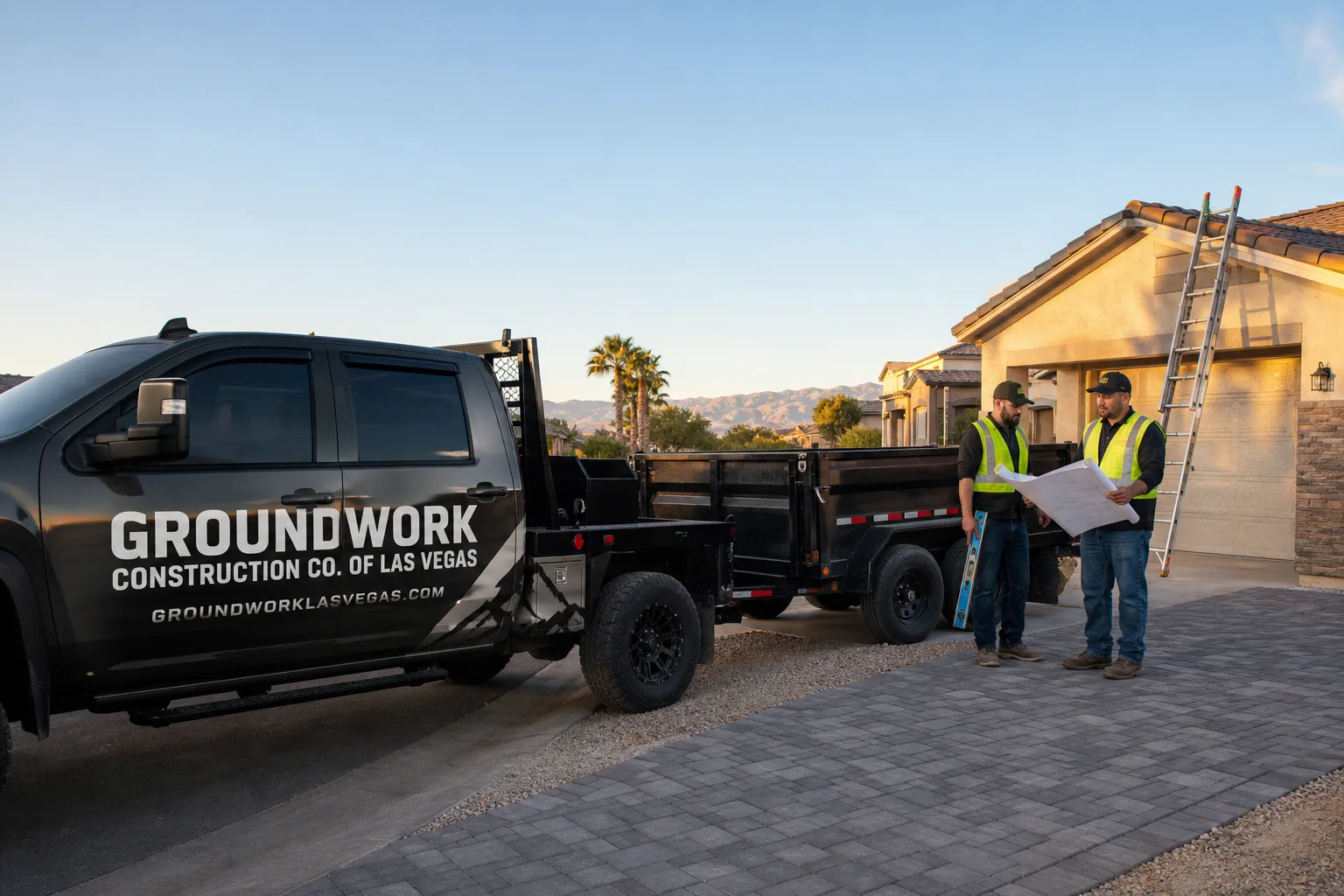
How Much Does a New Detached ADU Cost in Logandale?
A new detached ADU in Logandale typically runs $90,000-$220,000 and takes 4-7 months from permit approval to final inspection. Most builds we handle in the 89021 area are 400-800 square foot standalone units on rural acreage properties, often paired with workshops or guest quarters. Call (855) 951-4361 for a free on-site estimate - we’ll bring a tape measure and talk through your site-specific constraints.
Logandale’s rural character means these aren’t backyard cottages squeezed between fences. We’re building on properties with space, often adding heavy-duty garage doors, oversized entries for equipment, and longer service drives that standard Las Vegas ADU plans don’t account for. Homeowners here want it done right in one trip - they don’t call a contractor back for tweaks.
This page covers exactly what a new detached ADU involves in Logandale. If you’re looking at a broader home addition or attached expansion, see our full Home Additions & ADU in Logandale overview. For other projects, our Home Additions & ADU hub covers every market we serve.
How We Build a New Detached ADU - Start to Finish
We’ve refined this into five clear stages after building in Logandale and the broader Moapa Valley since 2014. Each stage has a decision point where your input keeps the job moving.
Stage 1: Site Evaluation and Flood Compliance (1-2 weeks)
We walk your property with a surveyor’s eye, checking the caliche depth, drainage patterns toward the Muddy River corridor, and your FEMA flood zone status. Most Logandale parcels sit in a floodplain that requires an elevation certificate before we can file for permits. You’ll decide: do we build on a stem-wall foundation with flood vents, or opt for a raised pier foundation if the certificate demands it? This choice alone can swing foundation costs by $8,000-$15,000.
Stage 2: Design and Permit Submission (3-6 weeks)
We draft plans that meet Clark County unincorporated building codes, not the simpler municipal standards some out-of-area crews assume apply. Logandale’s rural location means we file directly with the county, and we build in extra review time - county inspectors cover vast territory, and scheduling isn’t as tight as in Las Vegas. You’ll finalize square footage, roof style, and whether the unit connects to your existing septic or needs a separate system.
Stage 3: Site Prep and Foundation (2-4 weeks)
Here’s where the caliche hardpan hits. If our probe work showed shallow rock, we bring pneumatic breakers or a rock saw - equipment that standard desert excavation quotes skip. We grade for drainage away from the Muddy River flood corridor, pour footings with sulfate-resistant concrete to fight alkali soil attack, and set walls. You’ll inspect the foundation before we proceed; this is your last easy change point.
Stage 4: Framing, Systems, and Enclosure (4-8 weeks)
We frame walls, run electrical and plumbing (often extending lines 100+ feet from the main house), and install Specialty Roofing in Logandale. For Logandale’s 110°F summers, we spec radiant barrier sheathing and oversized HVAC rather than minimum-code units that fail in July. You’ll choose exterior finishes here - we typically recommend fiber-cement siding over vinyl, which warps and fades faster under Moapa Valley UV exposure.
Stage 5: Interior Finish and Final Inspection (2-4 weeks)
Flooring, fixtures, final electrical and plumbing hookups, then county inspection. We don’t call it done until it passes. Our Logandale crews know the inspectors by name, which means fewer re-inspection delays. You’ll do a walkthrough with our project lead; anything not right gets logged and fixed under our 730-Day Done Right Promise.
Serving Logandale, NV - Our Local Coverage Area
We’re based in the Logandale area and know this community well. Use the map below to see our service coverage - if you’re nearby, we can almost certainly help.
The Build Choices That Actually Matter
Every Overton New Detached ADU and Logandale project forces real trade-offs. Here’s where your money goes and what you sacrifice at each level:
- Foundation type: Slab-on-grade runs $12,000-$20,000 but fails in flood zones. Stem walls with flood vents add $8,000-$15,000 but keep you compliant and insurable. Raised piers cost most but handle the worst flood scenarios - necessary on some South Moapa Valley Boulevard parcels we’ve worked.
- Roofing system: Standard three-tab shingles cost least upfront but degrade in 10-12 years under Moapa Valley UV. GAF Timberline HDZ architectural shingles or CertainTeed Landmark products add $3,000-$6,000 but carry 50-year ratings and handle thermal cycling better. Metal roofing costs most, reflects heat aggressively, and lasts 40+ years - popular on workshop-ADU hybrids.
- HVAC approach: Mini-split systems ($2,500-$5,000 installed) work for smaller units but struggle in 110°F peaks. Central ducted systems with proper load calculations cost $5,000-$9,000 and don’t quit in August. We’ve replaced too many undersized mini-splits for Logandale homeowners who learned this the hard way.
- Exterior doors and hardware: Standard residential doors suffice for guest units. If you’re storing equipment, ATVs, or running a workshop, we install heavy-duty commercial-grade overhead doors with reinforced tracks - $1,500-$4,500 depending on size and insulation. The springs and openers we spec here are rated for daily cycling, not occasional residential use.
- Utility connections vs. standalone: Tapping existing septic and power saves $8,000-$15,000 but requires permits and capacity verification. Separate systems add cost and maintenance but eliminate dependency on your main house infrastructure - a common choice for rental ADUs where you want clean separation.
Homeowners often pair a