
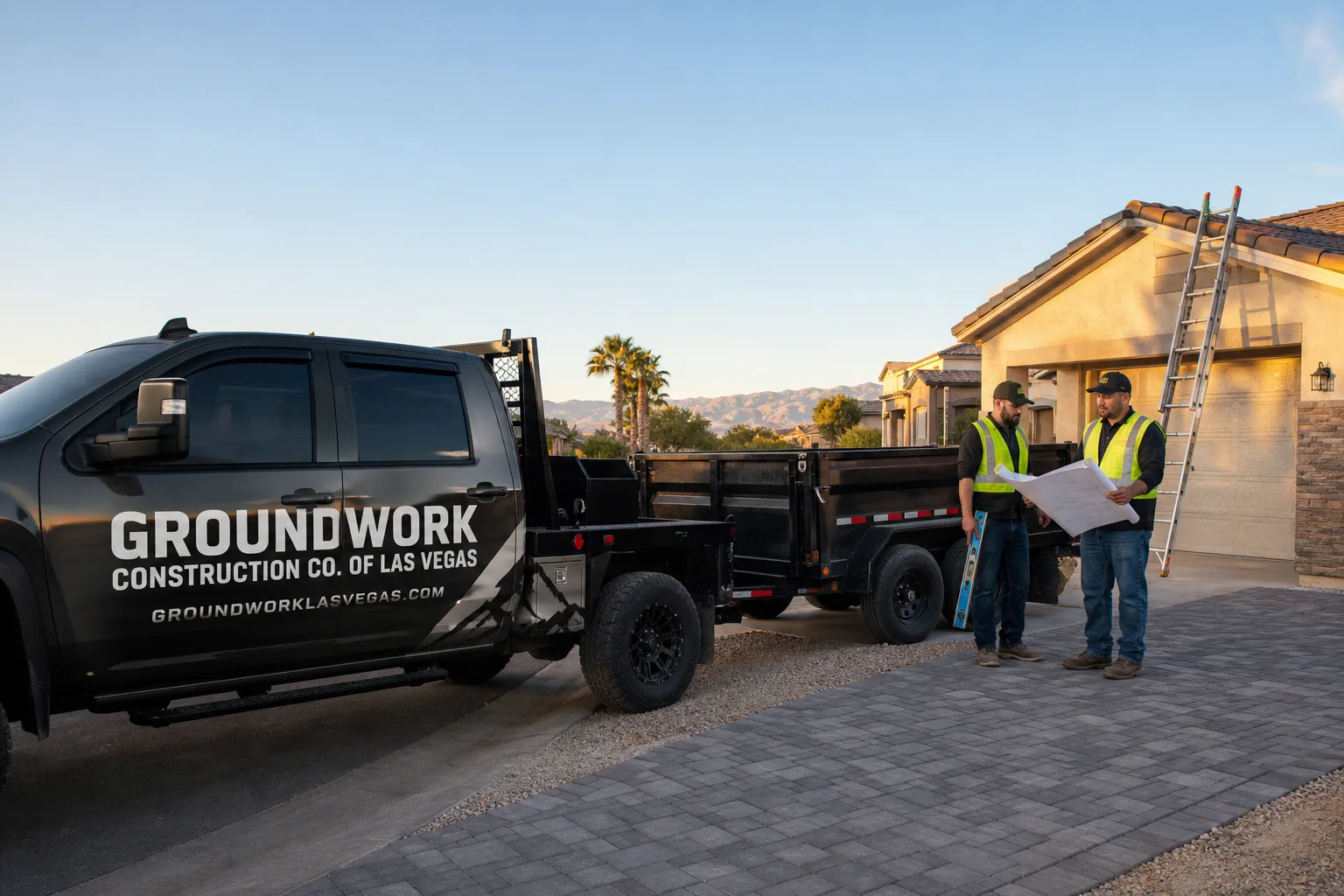
Paver Driveways in Moapa: Timeline, Cost, and What the Ground Here Demands
A professionally installed Moapa Driveway & Pavers project typically runs $7,000-$18,000 for a standard two-car residential installation, with most projects completed in 4-7 business days from excavation to final compaction. The caliche hardpan lurking 4-8 inches beneath Moapa’s surface makes site prep more involved than suburban Las Vegas jobs, so we probe every lot before quoting. Call (855) 951-4361 and we’ll send a crew to assess your specific soil conditions and provide a written, upfront estimate.
We’ve been building in this basin since 2014, and the paver driveways that hold up here are the ones where someone bothered to account for the ground before the first stone got laid.
How We Build a Paver Driveway in Moapa - Start to Finish
Every paver driveway we install follows a five-stage sequence. The timeline shifts based on your lot’s caliche depth, material availability from Las Vegas suppliers, and Clark County inspection scheduling, but here’s what happens:
Stage 1: Site probe and excavation (Day 1)
We arrive with a digging bar and a pneumatic probe to map your caliche layer before any equipment touches the ground. In Moapa, we’ve hit hardpan at 4 inches on some lots and 18 inches on others. This determines whether we’re using a standard mini-excavator or bringing in a breaker attachment. You’ll decide at this stage whether to adjust the driveway grade or relocate any irrigation lines that surface during probe. Most Moapa excavations take 4-6 hours, but caliche breakouts can push this to a full day.
Stage 2: Base installation and compaction (Days 1-2)
We lay 6-8 inches of crushed aggregate base, compacting in 2-inch lifts with a plate compactor rated for the load. In Moapa’s flash-flood corridors, we often increase base depth at the apron where storm surge crosses from the road. The base determines whether your pavers stay flat through summer monsoons. You choose the base specification here: standard DOT-grade aggregate or reinforced geogrid for heavier vehicle loads or expansive soil zones.
Stage 3: Edge restraint and bedding layer (Day 2-3)
We set concrete or aluminum edge restraints on a concrete haunch, then screed 1 inch of coarse bedding sand. This is where your pattern choice gets locked in - herringbone handles shear stress better for sloped approaches, while running bond works for flat grades. Most Moapa homes have enough grade change from garage to street that we recommend herringbone or basket-weave. Bedding sand placement takes 2-3 hours; we don’t leave it overnight exposed to wind, which is why we sequence this tight.
Stage 4: Paver laying and cutting (Days 3-5)
Our crew lays pavers to your chosen pattern, cutting border pieces with a wet saw on-site. Summer work in Moapa happens in early morning windows - by 10 a.m. in July, surface temperatures on dark pavers hit 140°F and sealants won’t cure properly. We stage material deliveries from Las Vegas for dawn arrival to avoid I-15 heat delays. You approve the field pattern before we cut the soldier course; changes after cutting cost material and time.
Stage 5: Compaction, joint sand, and final seal (Day 5-7)
We vibrate the pavers into the bedding layer, sweep polymeric joint sand, and compact again. Sealing happens only after joint sand has set 24 hours - in Moapa’s dry air, this can happen same-day, but we don’t rush it. You choose matte or wet-look sealer; wet-look intensifies color but requires reapplication every 2-3 years given our UV exposure. The 730-Day Done Right Promise covers settling, joint failure, and edge creep from this stage forward.
The Paver Choices You’ll Actually Decide Between
Not all pavers suit Moapa’s climate and soil. Here’s what we stock and why each does or doesn’t fit your situation:
- Standard concrete pavers (2 3/8″ thickness): The baseline for residential driveways. Rated for 8,000 psi, adequate for passenger vehicles on properly prepared base. Cost stays at the lower end of our range. Trade-off: color fades noticeably in our UV index by year 5-7; plan on sealant maintenance or accept the weathered look.
- Thick pavers (3 1/8″ or 3 15/16″): Required for any RV pad, equipment trailer, or frequent heavy loading. The deeper profile distributes load through caliche shifts better. Adds $1,200-$2,800 to a typical job. Trade-off: fewer color and texture options from most manufacturers; we source these specifically from Belgard’s heavy-duty line.
- Porcelain pavers: Impervious to moisture, stain-resistant, and color-stable for 15+ years in desert UV. Premium pricing pushes most jobs toward the $14,000-$18,000 range. Trade-off: requires a modified mortar-set installation rather than sand-set, extending timeline by 2 days and demanding perfectly flat base prep - caliche variability makes this riskier in Moapa.
- Permeable paver systems: Open-graded base and wider joints allow water infiltration, which helps with flash-flood runoff management on larger lots. Required by some Moapa Valley HOA covenants for properties over 1 acre. Trade-off: higher material cost, specialized joint aggregate, and annual vacuuming to prevent clogging from desert dust.
- Sealer selection (matte vs. wet-look vs. none): Matte sealer preserves natural texture, wet-look enriches color, unsealed lets the material age. In Moapa’s 115°F summer peaks, unsealed concrete pavers develop efflorescence (white mineral bloom) within 18 months. We recommend matte sealer as the practical default.
What Paver Driveways Cost in Moapa, NV
| Scope | Price Range |
|---|---|
| Standard two-car driveway (approx. 600 sq ft), concrete pavers | $7,000 - $11,500 |
| Three-car or extended RV pad, thick pavers | $12,000 - $18,000 |
| Caliche breakout / specialized excavation add | $800 - $2,500 |
| Permeable system upgrade | $1,500 - $3,000 |
| Porcelain paver material upgrade | $2,500 - $5,000 |
Five variables push your number within or beyond these ranges:
1. Caliche depth and excavation complexity. The probe tells us whether we’re removing topsoil or breaking rock. This is the Moapa-specific factor that never appears in Las Vegas bids.
2. Driveway size and configuration. Straight rectangles cost less than curved approaches, turnarounds, or integrated walkways. Every cut piece adds labor.
3. Material grade and thickness. Standard 2 3/8″ concrete pavers versus thick-profile or porcelain represents the widest material swing.
4. Existing driveway removal. Asphalt or concrete tear-out adds $1,200-$3,000 depending on thickness and access for hauling. Some Moapa lots have enough space to bury broken concrete on-site with county approval; others require trucking to Logandale or Las Vegas transfer stations.
5. Utility relocation. Rural Moapa properties often have shallow water lines, septic laterals, or irrigation crossing the driveway path. We mark and expose before excavation; relocating adds $400-$1,800 depending on depth and material.
Our written estimate includes excavation, base material, pavers, edge restraint, joint sand, compaction, and one sealer application. It does not include permit fees (typically $180-$350 for Clark County rural residential), utility relocation by outside trades, or tree/brush removal outside the driveway footprint.
What Moapa’s Ground and Climate Do to Paver Driveways
We’ve installed Driveway & Pavers services across Clark County, and Moapa presents a distinct set of conditions that reshape how we bid and build.
The caliche hardpan is the headline. In the Moapa basin, calcium carbonate cemented soil sits shallow enough that a standard post-hole digger bounces off it. For paver driveways, this means two things: excavation takes longer and costs more than the same job in Summerlin or Henderson, and the base preparation must account for minimal subgrade drainage. Water that penetrates the paver surface has nowhere to go through caliche, so we engineer the base slope and edge drainage more carefully than in permeable desert soils. We’ve seen driveways installed by out-of-area crews fail in two years because they assumed standard Las Vegas prep would suffice.
The heat is the second factor. Moapa Valley traps Mojave summer temperatures that peak 3-5 degrees above Las Vegas readings. We schedule paver deliveries for dawn arrival from suppliers on I-15, and we don’t seal in afternoon heat. The working window is 6 a.m. to 10 a.m. in July and August. This extends project duration by a day or two during peak summer, but rushing sealant application in 115°F conditions guarantees failure.
Flash flooding through desert washes crosses some developed parcels without warning during summer storms. For driveways adjacent to these corridors, we specify permeable base designs or integrated channel drains that wouldn’t be necessary in better-drained suburban lots. The housing stock here - manufactured homes on agricultural parcels, older ranch-style stick-built homes on private wells - often means we’re building driveways that must accommodate both daily passenger vehicles and occasional heavy equipment, which influences paver thickness specification.
Clark County permitting for rural unincorporated areas including Moapa requires a grading permit for any driveway exceeding 600 square feet or involving cut/fill over 12 inches. We handle permit submission and inspection scheduling; most rural inspections occur on Tuesdays with 48-hour notice. HOAs in the Moapa Valley area have varying covenants on material color and permeability; we verify these before finalizing material orders.
Homeowners often pair a new paver driveway with larger property improvements. If you’re considering a ADU Design & Permitting in Moapa or a Garage Conversion ADU in Moapa, we coordinate the driveway work with utility trenching and access planning so you’re not cutting new pavers six months later.
Serving Moapa, NV - Our Local Coverage Area
We’re based in the Moapa area and know this community well. Use the map below to see our service coverage - if you’re nearby, we can almost certainly help.
Frequently Asked - Paver Driveways in Moapa
Most residential paver driveways in Moapa take 4-7 business days from excavation to final seal. Caliche breakouts or summer heat restrictions can extend this to 8-10 days. We give you a firm timeline after the site probe, not before. Call (855) 951-4361 to schedule your probe - estimates are free.
Yes, if your driveway exceeds 600 square feet or requires cut/fill over 12 inches deep. Clark County’s rural unincorporated permitting applies to Moapa properties; we submit grading and building permits as part of our project management. Permit fees typically run $180-$350 and are not included in our base estimate.
We don’t recommend it for Moapa conditions. Existing asphalt or concrete in this climate has already settled unevenly; pavers laid on top will telegraph cracks and fail at joints within 2-3 years. Proper base prep requires removal to native soil, caliche assessment, and rebuilt aggregate base. The short-term savings aren’t worth the redo cost.
The lowest-cost viable installation uses standard 2 3/8″ concrete pavers in a simple running bond pattern on a straightforward rectangular layout with minimal caliche breakout. This typically lands near $7,000-$9,000 for a two-car driveway. We offer 0% financing for 18 months and $1,000 off projects over $10,000 to make the investment manageable - call (855) 951-4361 for exact numbers on your lot.
Every paver driveway we install is backed by our 730-Day Done Right Promise - if settling, joint failure, edge creep, or workmanship issues appear within two years, we repair at no charge. This is one of the longest workmanship guarantees in residential construction. Material defects carry manufacturer warranty separately. We put both in writing before work begins.
Get Your Moapa Paver Driveway Estimate
Call (855) 951-4361 and a live person will answer, 24 hours a day. We’ll schedule a site probe at your Moapa property, assess your caliche depth and drainage conditions, and deliver a written estimate with upfront pricing - no surprises, no pressure. Most estimates happen within 48 hours of your call. The 730-Day Done Right Promise and our background-checked, uniformed crew come standard on every job.
Written by Todd Mervyn, Owner at Groundwork Construction Co., serving Moapa and the greater Las Vegas region since 2014.