
Tile Roofing in Enterprise, NV: Timeline, Cost, and What to Expect
Tile roofing in Enterprise typically runs $15,000-$40,000 for a full installation and $600-$2,500 for targeted repairs, with most residential jobs completed in 5-10 business days depending on roof complexity and whether we’re working around existing tile or stripping to the deck. We’re Groundwork Construction Co., and our roofing crew has handled hundreds of tile roofs across unincorporated Clark County since 2014. Call (855) 951-4361 for a free on-site estimate - we answer live, 24/7.
How We Handle Tile Roofing Start to Finish
We break every tile roofing job into five clear stages so you know what’s happening overhead and when you’ll need to make decisions.
Stage 1: Deck inspection and moisture mapping (Day 1)
Before we lift a single tile, we walk the roof with moisture detection tools and inspect the underlying plywood or OSB from the attic side when accessible. In Enterprise, we regularly find that the 2003-2007 boom-era homes in subdivisions like Rhodes Ranch were built with adequate decking but minimal ventilation, so heat buildup in the attic has prematurely weakened the substrate. You’ll decide at this stage whether to spot-replace damaged decking or do a full re-deck. Spot work saves $800-$1,500; full re-deck adds $2,500-$4,500 but eliminates callbacks.
Stage 2: Tear-off and disposal (Days 1-2)
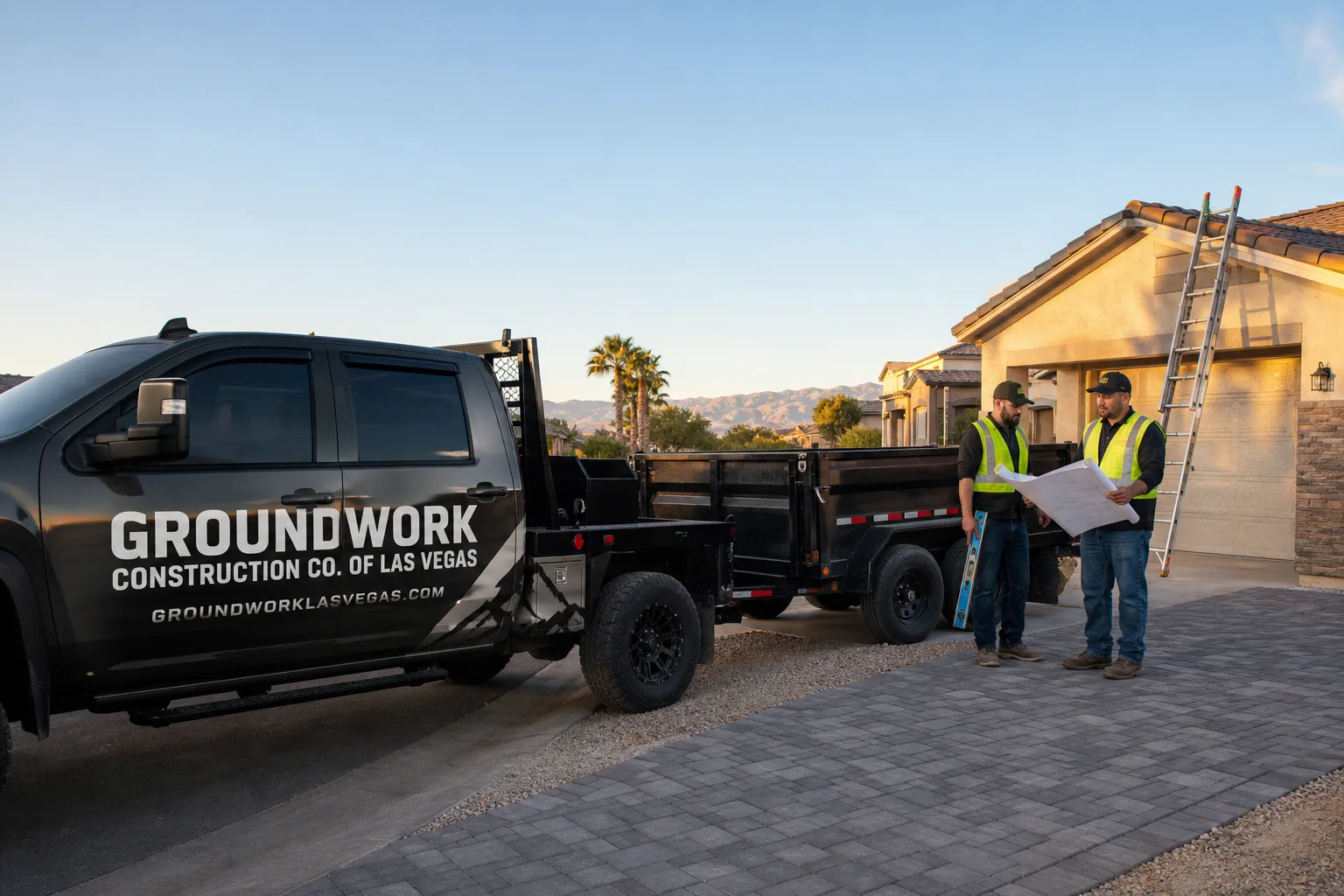
Concrete or clay tile weighs 800-1,200 pounds per square (100 sq ft), so we use dedicated roofing trailers rather than standard dumpsters to avoid driveway damage. The tear-off reveals the true condition of the underlayment - the waterproof barrier beneath the tile. In Enterprise’s 110°F summers, cheap felt underlayment degrades in 8-12 years. We typically recommend upgrading to a synthetic or self-adhering membrane at this point. You’ll see the exposed deck and approve the underlayment choice before we proceed.
Stage 3: Underlayment and flashings (Days 2-4)
This is where the actual waterproofing happens. Tile sheds water, but wind-driven rain and the rare hard desert downpour exploit any gap. We install valley metal, pipe boots, and wall flashings, then layer the underlayment with proper overlap and mechanical fastening. In Enterprise, Clark County inspectors check this stage specifically for nail pattern and penetration sealing. We schedule the inspection once the underlayment is fully exposed and before tile goes back on - it’s a critical checkpoint that protects your permit status.
Stage 4: Tile installation and ridge work (Days 4-8)
Tile goes on in courses from eave to ridge, with each piece mechanically fastened or foam-set depending on slope and wind exposure. You’ll have already chosen your tile profile - flat, S-tile, or barrel - and color blend. We order 10% overage for cuts and future repairs, standard in our estimates. Ridge caps and hip tiles get pre-bent mortar or foam adhesive. Most Enterprise homes have straightforward gable or hip roofs, but the larger tract homes in Southern Highlands with complex rooflines add 2-3 days for cutting and fitting.
Stage 5: Final inspection and walkthrough (Day 8-10)
Clark County requires a final roof inspection for all permitted tile work in unincorporated areas like Enterprise. We meet the inspector, verify uplift resistance and nail count, then walk the roof with you to show completed flashings, clean valleys, and our debris removal. The 730-Day Done Right Promise begins at final sign-off.
The Tile Choices That Actually Matter
Not all tile performs the same in Enterprise’s desert climate. Here’s what we see homeowners weighing:
- Concrete tile (low profile, flat or S-tile): The workhorse choice at $8-$12 per square foot installed. Concrete absorbs and releases heat slowly, which helps with attic temperatures but also creates thermal cycling stress over 15-20 years. It’s the most common replacement tile we install in Rhodes Ranch and nearby 2000s subdivisions because it matches original builder specs and satisfies most HOAs. Heavier than clay - verify your structure can handle it, though most Enterprise tract homes were engineered for concrete tile from day one.
- Clay tile (traditional or lightweight): $10-$16 per square foot installed. Fires hotter in production, so it’s more dimensionally stable and less prone to the surface crazing we see on aging concrete. The lightweight versions (under 600 lbs per square) work on homes where the original structure was marginal. Clay’s color persists longer under UV, a real factor when Enterprise summer sun indexes above 11 for months straight. The trade-off: more fragile during installation, and fewer local suppliers stock the premium Spanish profiles.
- Cool roof rated tile (concrete or clay with reflective surface): Adds $1-$2 per square foot but can reduce cooling loads 10-20% according to utility data we’ve tracked with customers. In Enterprise, where summer electric bills routinely spike above $400 for 2,500-square-foot homes, this pays back fastest on south- and west-facing roof planes. Not all HOAs allow the lighter colors, so we verify covenants before ordering.
- Underlayment grade (felt vs. synthetic vs. self-adhered): Felt is cheapest at material cost but lasts 10-15 years in our climate. Synthetic underlayment buys you 20-25 years and better tear resistance during installation. Self-adhered (peel-and-stick) membrane is the premium choice at roughly double the material cost, but it seals around every fastener and is the only underlayment we warranty for the full 730 days without reservation. On a 2,500-square-foot roof, the upgrade from felt to self-adhered runs $1,200-$1,800.
- Fastening method (screw/ring shank vs. foam adhesive): Screw or ring-shank nails are standard and required by Clark County in wind-exposed zones. Foam adhesive (polyurethane) sets faster and works well on low-slope tile applications common in some Enterprise patio covers and casitas, but it’s harder to repair piecemeal later. We recommend mechanical fastening for primary roof fields and reserve foam for specific architectural details.
We source tile through GAF and CertainTeed distribution channels, which gives us access to color-matching for discontinued builder grades - something that matters when you’re repairing a 2005 Rhodes Ranch roof and the original manufacturer folded.
What Tile Roofing Costs in Enterprise, NV
Tile roof installation in Enterprise ranges from $15,000 to $40,000; repairs run $600-$2,500. Here’s what pushes a job toward the high or low end:
| Cost Factor | Low-End Impact | High-End Impact |
|---|---|---|
| Roof size (per 1,000 sq ft) | $6,000-$8,000 | $10,000-$16,000 |
| Deck condition (full re-deck) | Included in base | +$2,500-$4,500 |
| Underlayment upgrade | Standard felt | +$1,200-$1,800 for self-adhered |
| Tile material (concrete vs. clay) | Concrete at $8-$12/sq ft | Premium clay at $14-$16/sq ft |
| Roof complexity (valleys, dormers, pitch) | Simple gable, walkable pitch | Multi-plane, steep pitch, +$3,000-$6,000 |
| Permit and inspection fees (Clark County) | $400-$600 typical | $800-$1,200 for complex or phased |
Our written estimates include tear-off, disposal, underlayment, tile, all flashings, permits, and final inspection. What’s not included: structural repairs beyond decking (rafter or truss work), gutter replacement (though we can quote it), or interior ceiling repair if leaks preceded our work. We provide upfront pricing, no surprises - the number you see is the number you pay, and we offer 0% financing for 18 months plus $1,000 off projects over $10,000.
Why Enterprise Homes Beat Harder on Tile Roofs
Enterprise’s unique position as unincorporated Clark County creates specific challenges that don’t exist three miles north in Las Vegas city limits. Every tile roofing permit must route through the Enterprise jurisdiction of the Clark County Building Department, not the City of Las Vegas. We’ve seen out-of-area crews submit to the wrong office and lose two weeks to rejection and re-filing. Our team pulls permits correctly the first time because we work this jurisdiction exclusively.
The housing stock tells the rest of the story. Those 2003-2007 tract homes in Rhodes Ranch, Southern Highlands, and the surrounding master-planned subdivisions are now 15-20 years old, and the original concrete tile is hitting its first replacement cycle. We see the same failure patterns repeatedly: underlayment dried and cracked from attic heat, mortar bedding at ridges crumbled from thermal cycling, and the occasional slab-shift crack in the stucco that telegraphs into the roof-to-wall junction. The caliche hardpan beneath Enterprise doesn’t cause foundation failure often, but when it does, the stress fractures show up first at roof penetrations and chimney flashings.
Because these subdivisions were built fast and in clusters, we can often negotiate material pricing for multiple homes in the same phase - something we pass through when neighbors coordinate timing. If you’re in an HOA, check your covenants before selecting tile color or profile; most require architectural committee approval for anything that changes the street-visible silhouette.
Tile roofing is often part of a full Roofing in Enterprise project, and some homeowners pair exterior work with Impact Windows & Doors in Enterprise or Sliding & Patio Doors in Enterprise to consolidate permits and minimize disruption. Our Roofing division coordinates with our windows crew when the scope overlaps.
Serving Enterprise, NV - Our Local Coverage Area
We’re based in the Enterprise area and know this community well. Use the map below to see our service coverage - if you’re nearby, we can almost certainly help.
Frequently Asked - Tile Roofing in Enterprise
Most residential tile roofing jobs in Enterprise take 5-10 business days from tear-off to final inspection, with simpler gable roofs on the shorter end and complex multi-plane designs or full re-decking on the longer end. Weather delays are rare in our climate, but Clark County inspector availability can add 1-2 days. Call (855) 951-4361 and we’ll give you a firm timeline with your estimate.
Yes - all tile roofing work in unincorporated Enterprise requires a Clark County Building Department permit, and the permit must specify Clark County jurisdiction, not City of Las Vegas. We handle the application, plans, and inspection scheduling as part of our standard process. Re-roofing without a permit risks fines and complicates future home sales.
We won’t, and any contractor who offers to “save money” by skipping underlayment replacement on a tear-off is creating a future leak. The underlayment is the actual waterproofing layer; tile is the protective shell. In Enterprise’s heat, old felt underlayment is typically brittle and compromised by the time tile needs replacement. Our 730-Day Done Right Promise requires that we install new underlayment on every full tile re-roof.
Tile costs roughly double asphalt upfront but lasts 40-50 years versus 15-20 for architectural shingles in our desert sun, and it adds resale value in Enterprise’s higher-end subdivisions. If you’re staying in the home 10+ years, tile’s lifecycle cost is lower. If you’re selling within 5 years, a quality asphalt re-roof may be the smarter spend. We’ll run both numbers honestly.
Our 730-Day Done Right Promise covers all workmanship - if it’s not done right, we make it right, one of the longest guarantees in residential roofing. Tile manufacturers (GAF, CertainTeed, and others we specify) provide material warranties from 50 years to lifetime depending on product line. We register your warranty and provide documentation at final walkthrough.
Get Your Free Tile Roofing Estimate in Enterprise
Call (855) 951-4361 now - a live person answers 24/7, no voicemail. We’ll schedule a free on-site estimate at your Enterprise home, inspect your current roof condition, and deliver upfront pricing with no surprises. Most estimates are completed in a single visit, and we can typically start tile roofing work within 2-3 weeks of approval.
Written by Todd Mervyn, Owner at Groundwork Construction Co., serving Enterprise and the Las Vegas Valley since 2014.