
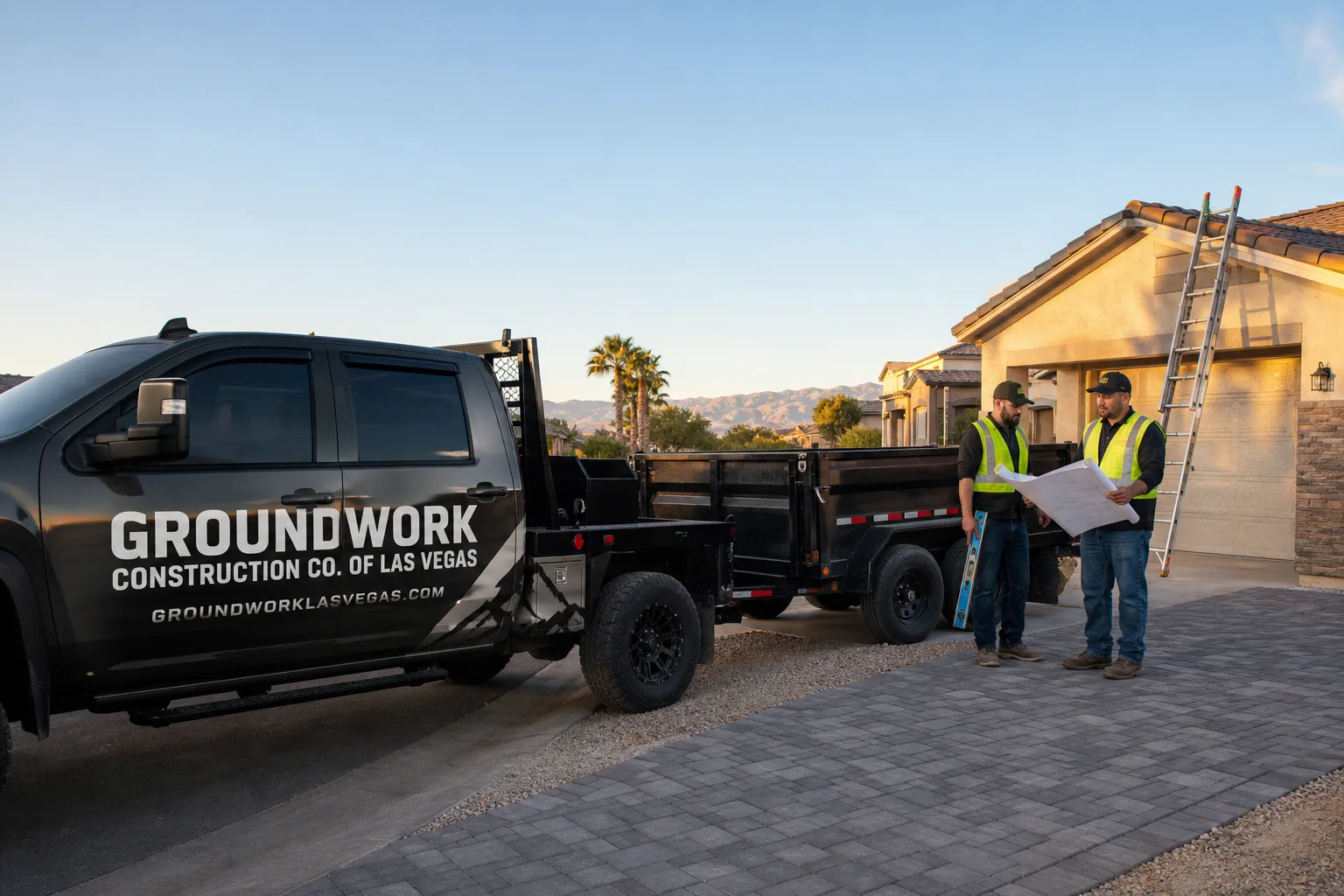
How Much Does a New Detached ADU Cost in Spring Valley?
A new detached ADU in Spring Valley typically runs $90,000-$220,000, with most of our clients landing in the $120,000-$160,000 range for a 400-800 square foot build with kitchenette, full bath, and independent utilities. Timeline from signed contract to certificate of occupancy is usually 5-7 months in Clark County, with permitting and utility coordination consuming roughly 8-12 weeks of that. Call (855) 951-4361 and we’ll walk your lot, check your setbacks against the latest county code, and give you a written estimate with actual numbers.
How We Build a New Detached ADU in Spring Valley - Start to Finish
We’ve built enough of these in Spring Valley to know where the surprises hide. Here’s the real sequence, with what you’re deciding at each stage and how long each phase takes.
Stage 1: Site evaluation and utility routing (Week 1-2)
We bring ground-penetrating radar to locate post-tension cables in your main house slab and any existing hardscape we might need to cut. We also probe for caliche depth, because in Spring Valley we’ve hit hardpan at 8 inches in some lots and 4 feet in others. You’ll decide whether to trench new utilities from the street or tap from your main house panel and meter. Tapping is cheaper; independent metering gives you rental flexibility later.
Stage 2: Design, permitting, and HOA coordination (Week 2-10)
Our drawings go to Clark County Building Division for plan check. Spring Valley falls under unincorporated Clark County jurisdiction, so we deal directly with county inspectors, not a city office. If your neighborhood has an active HOA, we submit exterior materials and massing for approval simultaneously. You’ll pick your exterior finish, roof profile, and window placement during this window. Delays here are almost always HOA-related, not county-related.
Stage 3: Foundation and underground rough-in (Week 11-14)
Caliche breaking or rock-sawing happens first, then footings and slab pour. We schedule concrete for before sunrise, standard practice in the Las Vegas Valley when summer temperatures crack 110°F by 10 a.m. Your plumbing, electrical, and sewer lines go in before the slab sets. You’ll confirm fixture locations now; moving a toilet flange after this costs roughly $800-$1,400.
Stage 4: Framing, dry-in, and MEP rough (Week 15-20)
Walls and roof structure go up, followed by windows, exterior doors, and weather barrier. We use James Hardie fiber-cement siding on most Spring Valley ADUs because it handles our UV load and thermal cycling better than vinyl, which gets brittle and faded inside of 8 years here. Electrical panel, HVAC mini-split, and water heater rough-in happen now. You’ll choose interior flooring and cabinet grade.
Stage 5: Finishes, final inspection, and utility activation (Week 21-26)
Drywall, paint, flooring, cabinets, countertops, fixtures, and appliances. Final county inspection covers structural, electrical, plumbing, and energy code compliance. We coordinate NV Energy and Southwest Gas for meter activation. You’ll do a walkthrough with our project lead; anything not matching the signed scope gets punched out before we hand over keys.
This is part of a full Home Additions & ADU in Spring Valley portfolio, and our Home Additions & ADU crew handles everything from foundation to finish line without subcontractor gaps.
The Build Options You’ll Actually Choose Between
- Stick-built on permanent foundation vs. prefab modular: Stick-built gives you custom layout and matches your main house roofline exactly; figure $110-$160 per square foot in Spring Valley. Prefab units from Plant Prefab or Boxabl drop in faster and can cut 3-4 weeks off timeline, but you’re working within their module dimensions and crane access becomes your constraint. Best for flat lots with alley or side-yard delivery.
- Utility tie-in vs. independent meters: Tapping your existing 200-amp panel and water main saves $4,000-$8,000 upfront. Separate meters let you rent the unit as a legal dwelling with its own bills, but Southwest Gas and NV Energy each charge connection fees that add $2,500-$5,000. Most of our Spring Valley clients building for rental income go independent; those building for family go tied-in.
- Mini-split heat pump vs. packaged HVAC: Mini-splits are quieter, more efficient, and don’t need ductwork, which matters in tight 400-square-foot plans. Packaged units cost less upfront but burn more electricity July through September when Spring Valley hits 115°F. We size for peak load, not average.
- Standard stucco vs. James Hardie with trim: Stucco matches most Spring Valley tract homes from the 1980s and 1990s. James Hardie costs 15-20% more but won’t spider-crack from thermal expansion the way stucco does after 10-15 years of our sun exposure. If your HOA requires stucco match, we spec elastomeric color coat over conventional cement.
- Compact kitchenette vs. full kitchen: A 30-inch cooktop, under-counter fridge, and single-bowl sink runs $3,500-$6,000. Full-size appliances, dishwasher, and quartz counters push to $9,000-$14,000. Rental ADUs in Spring Valley rent for roughly $1,200-$1,800 monthly; the full kitchen pays back faster.
What New Detached ADU Costs in Spring Valley, NV
| Component | Low Range | Mid Range | High Range |
|---|---|---|---|
| Base construction (400-800 sq ft) | $90,000 | $130,000 | $180,000 |
| Caliche/rock excavation (if required) | $2,500 | $5,000 | $12,000 |
| Independent utility connections | $3,000 | $5,500 | $8,000 |
| Kitchenette (compact) | $3,500 | $5,000 | $7,000 |
| Full kitchen with appliances | $9,000 | $12,000 | $16,000 |
| Permits, fees, and plan check | $4,000 | $6,000 | $9,000 |
| Total project range | $90,000 | $140,000 | $220,000 |
Five factors push you toward the high end: size over 600 square feet, caliche depth requiring pneumatic breaking, relocating the main house electrical panel to accommodate the ADU load, upgrading to a full kitchen with gas range, and HOA-mandated architectural upgrades beyond county minimums. The low end assumes flat grade, minimal excavation, tied-in utilities, and compact finishes.
Our written estimates include all labor, materials, permits, and the 730-Day Done Right Promise. What they don’t include: your appliance package (we rough in; you buy), window coverings, or landscaping restoration beyond basic grading and seed. Upfront pricing, no surprises.
We also serve Spring Valley homeowners who want to coordinate their ADU with interior work. Many pair this with Kitchen Design & Layout in Spring Valley for the main house, or Backsplash, Tile & Flooring in Spring Valley to unify finishes across both structures.
What Spring Valley Homes Specifically Do to This Job
Spring Valley’s housing stock is almost entirely single- and two-story stucco-clad wood-frame tract homes built between the late 1970s and mid-1990s, sitting on post-tension concrete slabs with caliche hardpan underneath. That combination changes nearly every decision in a new detached ADU build.
The post-tension cables are the big one. Cutting one releases thousands of pounds of stored tension and can compromise your main house structurally. We carry GPR and cable-locating wands on every job that touches existing concrete. Out-of-state contractors who’ve never worked Las Vegas Valley soil often skip this step entirely. We’ve been called in twice in the past three years to fix slab failures caused by crews who didn’t.
Caliche depth varies block by block. Near Flamingo Road and south of Spring Mountain Road, we’ve hit rock-saw conditions at 18 inches. Further west toward Desert Inn Road, some lots allow conventional trenching. We probe during evaluation so you’re not surprised by a $7,000 excavation line item after contract.
UV degradation is another local factor. Sealants and caulks that last 15 years in Portland fail in 6-8 here. We spec silicone-polymer hybrid sealants on all exterior penetrations and use GAF or Owens Corning roofing materials rated for desert exposure. The monsoon bursts we get July through September will find any grading mistake immediately; we slope hard away from foundations and use French drains where lot lines pinch.
HOA oversight is heavier in the master-planned pockets west of Rainbow Boulevard. Some require architectural review committees to approve roof pitch, exterior color, and even window grille pattern before Clark County ever sees plans. We handle both tracks simultaneously so county approval doesn’t sit idle waiting for HOA sign-off.
Serving Spring Valley, NV - Our Local Coverage Area
We’re based in the Spring Valley area and know this community well. Use the map below to see our service coverage - if you’re nearby, we can almost certainly help.
Frequently Asked - New Detached ADU in Spring Valley
Most new detached ADU projects in Spring Valley take 5-7 months from contract to move-in, with permitting and utility coordination eating 8-12 weeks of that. Actual construction moves fast once we break ground; the delays are almost always county plan check or HOA architectural review. Call (855) 951-4361 and we can check current Clark County turnaround times for your specific lot.
Yes. Spring Valley is unincorporated Clark County, so you need a county building permit covering structural, electrical, plumbing, and mechanical work. You’ll also need separate utility connection approvals from NV Energy and Southwest Gas. We pull all permits as part of our scope; you never visit the county office. Our estimates include permit fees, which run $4,000-$9,000 depending on ADU size and utility complexity.
You can, but you’ll limit your options. Tying into existing utilities avoids relocating your main house panel or water line, saving $4,000-$8,000. However, if your main panel is only 100 amps or your water pressure is marginal, you’ll need upgrades anyway. We evaluate both paths during site visit and tell you which makes financial sense for your specific setup.
No. A new detached ADU costs more because you’re building from dirt, running new utilities, and pouring a separate foundation. Garage conversions start around $30,000 because the structure, slab, and utility rough-ins exist. But detached ADUs command higher rental income, offer more privacy, and don’t sacrifice your parking. For rental-focused clients in Spring Valley, the detached unit typically pays back its premium in 4-6 years.
Every new detached ADU we build in Spring Valley is covered by our 730-Day Done Right Promise. If anything we installed fails due to workmanship or material defect within two years, we repair or replace it at no charge. That’s one of the longest residential construction warranties available, and we put it in writing on every contract. Structural elements carry additional manufacturer warranties: 30 years on James Hardie siding, 50 years on GAF shingles where specified.
Ready to Talk Through Your Spring Valley Lot?
Call (855) 951-4361 and a live person will answer, 24/7. We’ll schedule a free on-site estimate, walk your property for caliche and utility access, check your setbacks against Clark County’s current ADU ordinance, and deliver a written scope with real numbers. No deposit required to get your estimate. From foundation to finish line, we build it right and back it in writing.
Written by Todd Mervyn, Owner at Groundwork Construction Co., serving Spring Valley since 2014.