
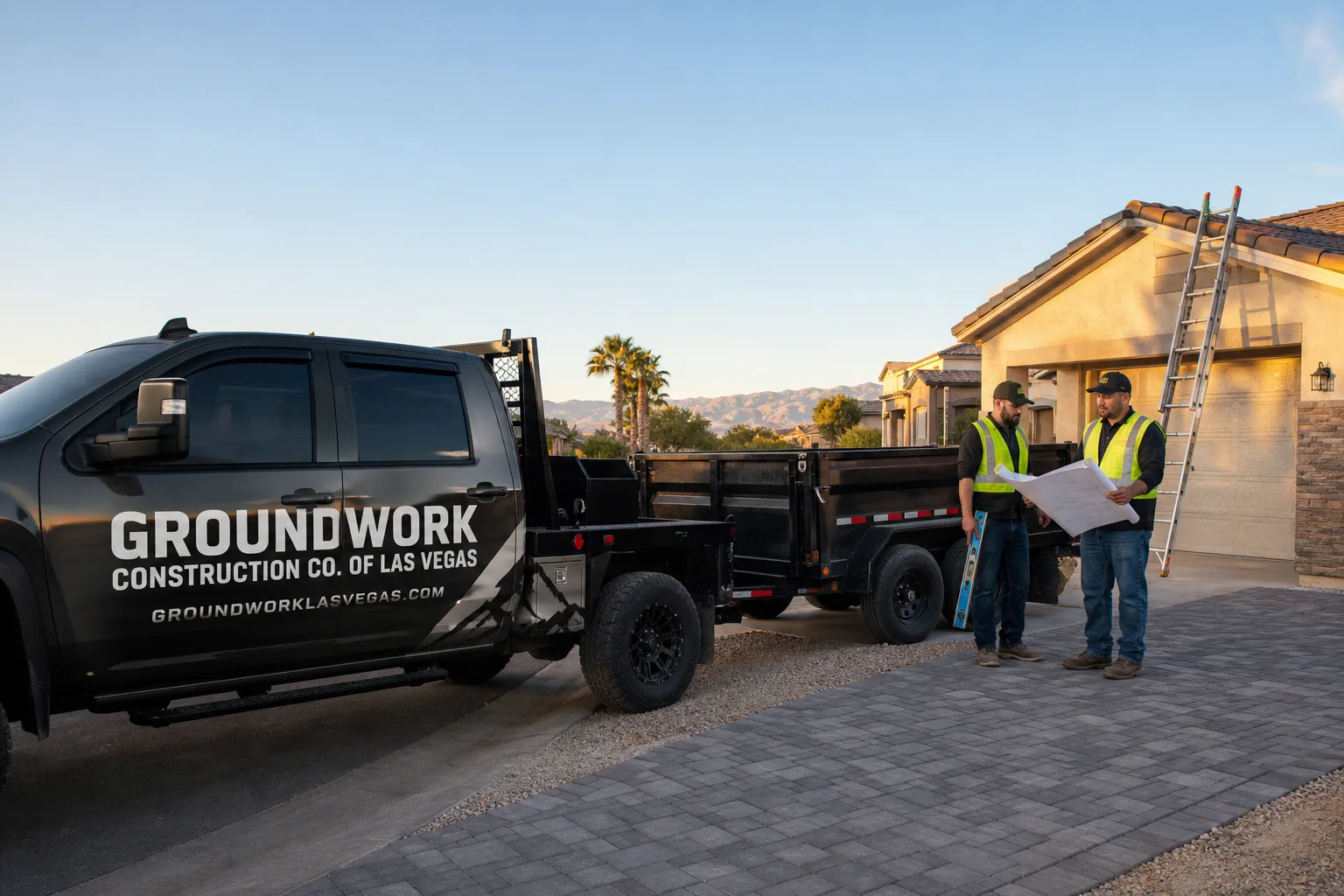
Paver Driveways in Sloan, NV: What to Expect, What It Costs, and How Long It Takes
Paver driveway installation in Sloan typically runs $7,000-$18,000 for a standard residential job, with most projects completed in 4-7 business days from excavation to final compaction. We handle everything from caliche breaking and subgrade prep through base installation and paver laying, and we answer calls live at (855) 951-4361 if you want to walk your lot specifics with us.
Out here on the southern fringe of the Las Vegas Valley, we’ve learned that a paver driveway isn’t just about curb appeal. It’s about building something that won’t heave, settle, or wash out when the monsoons hit a freshly graded lot. Sloan’s raw desert terrain - especially the undeveloped parcels along Saint Rose Parkway and the lots backing up to the open desert near West Starr Avenue - demands a heavier-duty approach than you’ll find in established neighborhoods north of the 215. We’ve jackhammered through four feet of caliche on jobs near The Core at Southern Highlands. We’ve also seen what happens when crews skip the geotextile layer on a 110°F July afternoon and the base starts pumping. This page covers how we actually build paver driveways in Sloan, what you’ll pay, and what Sloan’s specific ground conditions mean for your timeline.
How We Build a Paver Driveway in Sloan - Start to Finish
We break every paver driveway into five distinct stages. Each one has a clear deliverable, a realistic duration, and a decision point where we need your input before moving forward.
Stage 1: Site Evaluation and Caliche Assessment (Day 1)
We walk the lot with you, mark utility locations, and probe or test-pit to determine caliche depth. On virgin Sloan lots, we routinely find 2-4 feet of calcium-carbonate hardpan. If we’re over 18 inches, we bring in a pneumatic breaker or hoe-ram and adjust the excavation scope. You decide at this stage: do we remove all caliche to workable soil, or do we design a thickened aggregate base that bridges over it? The first option costs more upfront but eliminates long-term settlement risk. The second saves money but requires a heavier geotextile and more compacted base depth. We’ll give you both numbers in writing.
Stage 2: Excavation and Subgrade Prep (Days 2-3)
We cut to grade, typically 10-14 inches below finished driveway elevation depending on traffic load and soil condition. In Sloan’s 89054 ZIP, we often hit that stubborn hardpan layer within the first shovel depth. Our crew factors a dedicated caliche-breaking line item into every Sloan bid - something out-of-area contractors frequently miss. Once we’re through, we proof-roll the subgrade with a loaded dump truck or plate compactor, looking for soft spots. Any pumping or rutting gets dug out and replaced with compacted fill. This stage determines whether your driveway lasts 15 years or needs relaying in five.
Stage 3: Base Installation and Compaction (Days 3-4)
We lay geotextile fabric to separate native soil from aggregate, then build the structural base in 4-inch lifts of crushed stone (typically 3/4-inch minus with fines). Each lift gets compacted to 95% standard Proctor density. On Sloan’s caliche-heavy sites, we often go with an 8-10 inch base instead of the standard 6 inches. You choose the base depth based on our recommendation and your budget. We also slope everything for drainage during this stage - critical here, where summer cloudbursts can dump an inch of rain in twenty minutes on lots that haven’t developed natural drainage patterns yet.
Stage 4: Paver Bedding, Laying, and Edge Restraint (Days 4-6)
We screed a 1-inch bedding course of coarse concrete sand, then lay pavers to your chosen pattern. Edge restraints get spiked into concrete haunches, not just tacked into aggregate - the thermal expansion out here is real, and flexible edging fails within two seasons. You make the final call on pattern (herringbone handles vehicle loads best, running bond looks cleaner on long drives), color blend, and whether we include soldier course borders. We cut with a wet saw for clean joints against existing concrete or structures.
Stage 5: Compaction, Joint Sand, and Final Walk (Day 6-7)
We plate-compact the laid field, sweep in polymeric sand to lock joints, compact again, and do a final wash and inspection. You walk it with us. If anything’s off, we fix it before we leave. That’s the 730-Day Done Right Promise in action - if it’s not right, we make it right.
The Paver Options You’ll Actually Choose Between
Most Sloan homeowners narrow their decision to three or four variables. Here’s how they break down:
- Concrete pavers vs. clay brick: Concrete dominates here for good reason - it handles the thermal cycling better, comes in thicker profiles (60mm or 80mm vs. standard 50mm brick), and costs less per square foot installed. Clay brick looks richer and weathers to a softer patina, but it’s harder to source in the quantities needed for a full driveway and can spall under heavy vehicle loads on an insufficient base. Most of our Sloan jobs use 80mm concrete pavers rated for vehicular traffic.
- Standard vs. permeable pavers: Standard pavers with tight joints and a solid base shed water to the edges. Permeable pavers with wider joints and an open-graded stone base let water infiltrate - useful if you’re managing runoff on a large lot or working with Clark County drainage requirements on new construction. Permeable adds $2-$4 per square foot and requires a deeper, cleaner aggregate base. We recommend it for properties near the undeveloped desert edge where sheet flow can erode unprotected slopes.
- Color and finish: Smooth finishes look clean but can get slick when wet - a consideration during those July-September downbursts. Tumbled or textured finishes hide dust and provide better traction. In Sloan’s high-UV environment, we steer clients toward lighter earth tones (tans, buffs, light grays) that don’t absorb as much heat and are less prone to surface fading. Dark charcoal looks sharp in the showroom but can hit 140°F surface temperature at 2 PM in August.
- Pattern geometry: Herringbone at 45 or 90 degrees is the strongest for vehicle loads because it locks edge-to-edge. Running bond works for lighter-duty applications and gives a more modern, elongated look. Basketweave is available but we don’t recommend it for driveways - the long joints can open up under turning loads.
- Border treatment: A contrasting soldier course (single or double row) frames the field and contains edge migration. On long rural drives common near East Starr Avenue, we often use a darker border to break up the visual mass. It’s a small material upcharge that pays off in finished appearance.
We’re a Driveway & Pavers crew first, but we coordinate with our full construction team when your project is part of a full Driveway & Pavers in Sloan scope that includes walkways, patios, or hardscape lighting.
What Paver Driveways Cost in Sloan, NV
| Cost Factor | Typical Range Impact |
|---|---|
| Base job, 2-car driveway (approx. 600 sq ft) | $7,000-$10,500 |
| Mid-size driveway with caliche breaking (800-1,000 sq ft) | $10,500-$14,000 |
| Large or premium install (1,200+ sq ft, permeable pavers, complex pattern) | $14,000-$18,000 |
| Caliche breaking per foot of depth over 18 inches | Adds 15-25% to excavation |
| Permeable paver upgrade | Adds $2-$4/sq ft |
| Thickened base (8-10″ vs. standard 6″) | Adds $1.50-$2.50/sq ft |
Five variables push your number up or down. Driveway size is obvious - we price by the square foot, and rural Sloan lots often need longer service drives than standard suburban layouts. Caliche depth is the big unknown; we’ve hit none on regraded infill lots near Silverado Ranch and four feet on raw desert parcels. Material grade - standard 60mm pavers vs. 80mm vehicular-grade, domestic vs. imported - moves the material line 20-40%. Site access matters too; if we can’t get a mini-excavator to the work area and have to hand-dig or use smaller equipment, labor hours stack up. Drainage complexity
- whether we’re tying into existing storm systems or creating new swales - adds engineering and sometimes permit scope. Our written estimate includes excavation, disposal, base materials, pavers, edge restraint, bedding sand, polymeric sand, compaction, and cleanup. It does not include permit fees (if required), utility locates (we coordinate them but the utility charges), or any irrigation or landscape repair outside the driveway footprint. Upfront pricing, no surprises - the number you see is the number you pay. Homeowners in Sloan often pair a new paver driveway with larger property improvements. If you’re considering adding living space, we also handle ADU Design & Permitting in Sloan and Garage Conversion ADU in Sloan - projects that frequently share the same caliche-breaking reality and can be sequenced to save on mobilization costs.
What Sloan’s Ground and Climate Do to This Job
Sloan isn’t Las Vegas proper, and building here like it is costs homeowners money.
The 89054 ZIP sits at the collision point between developed Southern Highlands and open Mojave desert. Lots near Jimmy Pettyjohn Jr Park and the newer plats off Saint Rose Parkway have been graded and built on since the early 2000s - caliche’s been busted, fill’s been engineered, and drainage patterns are established. But step onto raw acreage toward the I-15 corridor or the parcels west of West Starr Avenue, and you’re dealing with virgin desert. We’ve watched excavator teeth glow dull-red chewing through that cemented hardpan. Out-of-town bidders who price it like a Summerlin infill job eat the difference or walk offsite.
The thermal swing is brutal too. Summer days at 110°F followed by 75°F nights create expansion-contraction cycles that stress rigid paving systems. That’s why we specify concrete pavers with ASTM C936 certification, use sand-set bedding (not mortar), and design expansion joints at structure interfaces. The monsoon season adds another variable - intense rainfall on poorly draining caliche substrate can saturate a freshly placed base before it compacts. We check weather windows and protect work in progress.
Most Sloan homes we work on are stucco-over-wood-frame builds from 2000 forward, following modern Clark County codes. Driveway connections to these structures need deliberate expansion-joint detail to prevent cracking where the rigid paver field meets the flexible structure. We see failure modes here that don’t show up in older, pre-code housing stock: insufficient base depth on builder-grade original driveways, no geotextile separation, and edge restraint that popped within three years because it wasn’t set in concrete. When we replace these, we build to a standard that handles what Sloan’s specific conditions throw at it.
Serving Sloan, NV - Our Local Coverage Area
We’re based in the Sloan area and know this community well. Use the map below to see our service coverage - if you’re nearby, we can almost certainly help.
Frequently Asked - Paver Driveways in Sloan
Most residential paver driveways in Sloan take 4-7 business days from mobilization to final compaction. Caliche depth is the biggest variable - a lot with minimal hardpan moves faster than one requiring two days of breaker work. We’ll give you a firm schedule after the Day 1 site evaluation. Call (855) 951-4361 to book that walkthrough - estimates are free.
Replacement of an existing driveway in the same footprint typically does not require a Clark County building permit, but new driveway construction or any work affecting drainage, curb cuts, or right-of-way does. We handle permit determination as part of our initial site evaluation and pull any required permits ourselves so you don’t have to navigate county offices. Call (855) 951-4361 and we’ll confirm your specific situation.
Yes, if the lines run under the driveway footprint and are in good condition, we can often bridge over them with a thickened base or schedule our excavation to expose and protect them. If they’re deteriorated or improperly sleeved, we’ll flag the issue and give you a repair option before we proceed. We don’t bury problems - the 730-Day Done Right Promise means we fix what we find, not pretend we didn’t see it.
Initial installed cost for pavers runs higher than standard broom-finish concrete - typically 20-40% more for an equivalent size - but pavers offer repairability (individual units can be replaced), no cure time (you drive on them immediately), and better performance on Sloan’s expansive soils and caliche substrates. Over a 15-20 year horizon, the lifecycle cost often favors pavers, especially if the concrete alternative would need replacement due to cracking. We price both if you want the comparison - call (855) 951-4361.
Every paver driveway we install is covered by our 730-Day Done Right Promise - if it’s not done right, we make it right. This covers workmanship, base integrity, and paver installation. Material defects fall to the manufacturer’s warranty, which we help you file if needed. We also background-check and uniform every technician, and we’ve been serving this region since 2014. Built to last, backed in writing.
Get Your Free On-Site Estimate for Paver Driveways in Sloan
We’ll walk your lot, probe the caliche, and give you a written estimate with real numbers - no phantom charges, no “we’ll figure it out later.” Calls are answered by a live person, 24/7, and we offer 0% financing for 18 months plus $1,000 off projects over $10,000. Call (855) 951-4361 today or request your free project estimate online. Most Sloan evaluations get scheduled within 48 hours.
Written by Todd Mervyn, Owner at Groundwork Construction Co., serving Sloan since 2014.