
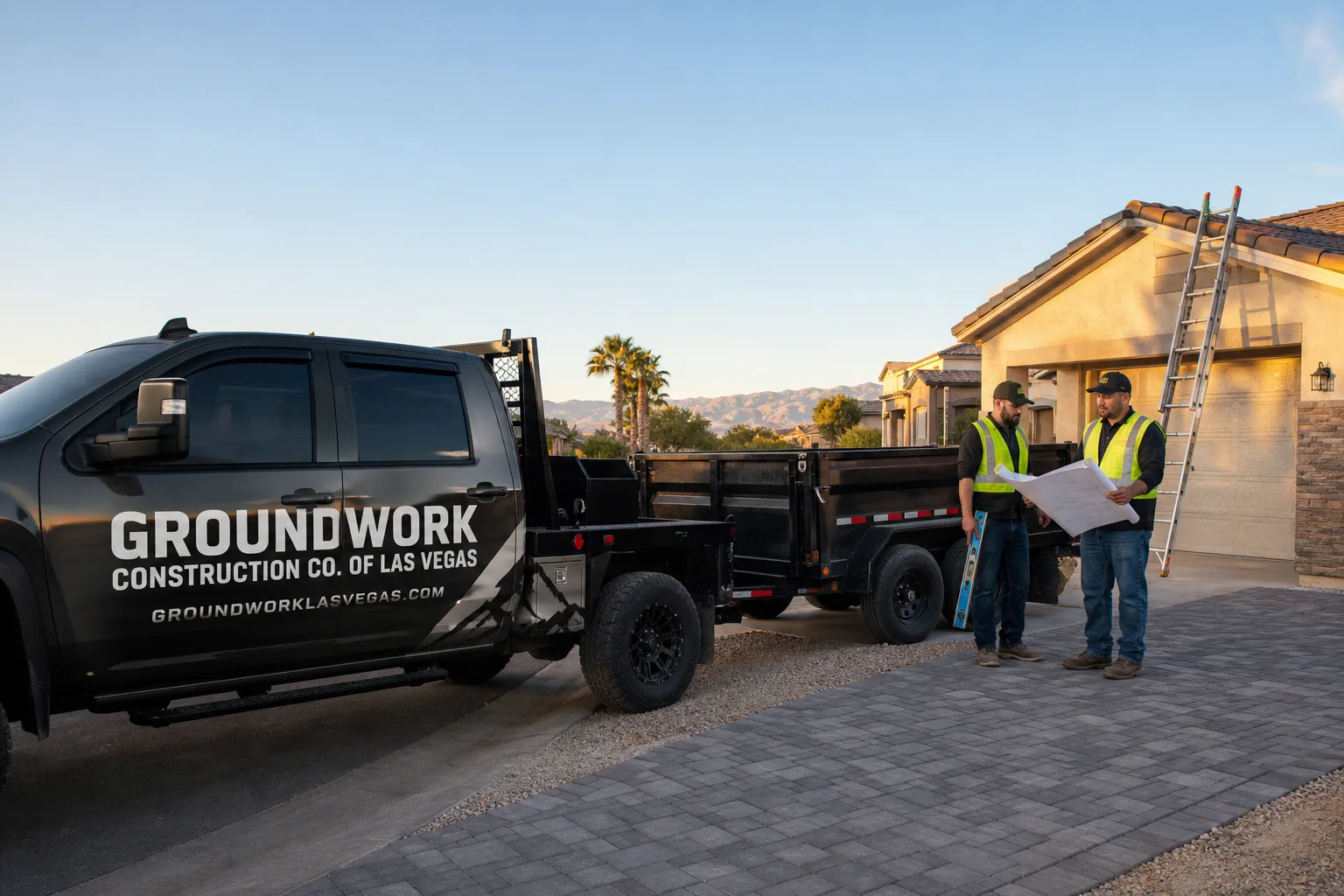
Paver Driveways in Spring Valley, NV - Cost, Timeline, and What to Expect
A paver driveway installation in Spring Valley typically runs $7,000-$18,000 for a standard two-car residential driveway, with most jobs completed in 3-5 business days once materials arrive. We handle permitting through Clark County, prep for the caliche hardpan common in this area, and back the finished work with our 730-Day Done Right Promise. Call (855) 951-4361 for a free on-site estimate and written quote.
How We Install Paver Driveways - Start to Finish
Every paver driveway we build in Spring Valley follows the same five-stage sequence. Homeowners know exactly where we are, what happens next, and what decision they need to make before we move forward.
Stage 1: Site measure and utility check (Day 1, 2-3 hours)
We mark the exact driveway footprint, locate sprinkler lines, and identify whether your home sits on a post-tension slab - nearly universal in Spring Valley’s 1970s-1990s housing stock. If the driveway runs adjacent to the foundation, we bring in cable-locating equipment to avoid cutting tensioned steel. You decide the final dimensions and whether to widen for RV or guest parking.
Stage 2: Demolition and excavation (Days 1-2)
Existing concrete, asphalt, or old pavers come out. Then we hit the caliche. This dense calcium-carbonate layer sits under most of Spring Valley and stops standard digging equipment cold. We use pneumatic breakers or rock saws to reach proper depth - typically 8-10 inches for residential vehicle loads. The extra labor here is why Spring Valley paver jobs often run higher than bids from contractors who don’t account for it.
Stage 3: Base installation and compaction (Days 2-3)
We lay geotextile fabric, then build the aggregate base in two lifts - crushed stone compacted with a plate compactor between layers. Proper base depth and compaction density determine whether your driveway stays flat or develops dips and weed growth in year three. You choose whether to add edge restraints in aluminum, steel, or concrete - aluminum handles Spring Valley’s thermal expansion best.
Stage 4: Sand bedding and paver laying (Days 3-4)
A 1-inch screeded sand bed goes down, then we lay pavers in your chosen pattern. Herringbone handles vehicle turning stress better than running bond. We cut border pieces with wet saws, not angle grinders, for clean edges that won’t chip. This is when you see the driveway take shape - and when any last-minute pattern adjustments get made.
Stage 5: Compaction, joint sand, and sealing (Day 5)
We vibrate the pavers into the sand bed, sweep polymeric joint sand into gaps, and compact again. Sealer goes on 48-72 hours later, after the surface is fully clean and dry. In Spring Valley’s UV-intense climate, we use a breathable, solvent-based sealer rated for 110°F+ application - water-based products flash-cure and flake off here.
From first call to final walkthrough, most Spring Valley paver driveway projects take 2-3 weeks including material delivery and permit approval. Rush jobs are possible if stock is local, but we don’t rush the base - that’s where driveways fail.
The Paver Materials You’ll Actually Choose Between
Not all pavers suit Spring Valley’s freeze-thaw cycles, thermal expansion, and monsoon drainage. Here’s what we stock and why homeowners pick one over another:
- Concrete pavers (standard grade, 2⅜-inch thickness): The practical choice for most Spring Valley driveways. Cost-effective at $7,000-$12,000 for typical two-car coverage. Colors fade gradually in our UV exposure; expect to reseal every 2-3 years. Best for homeowners who want a clean look without premium spend.
- Concrete pavers (premium grade, 3⅛-inch thickness, beveled edge): Heavier body, tighter dimensional tolerance, richer color saturation through the full paver - not just the top layer. Runs $11,000-$16,000. The extra thickness matters on caliche subgrades where minor settling occurs. We recommend these for driveways with slope or turning-radius wear.
- Permeable pavers (open-graded base system): Required by some Spring Valley HOAs for water-management compliance. Gaps between pavers drain runoff into a rock reservoir below, reducing flooding during July-September monsoon bursts. Higher material cost and specialized base labor push these to $12,000-$18,000. Ideal for properties with drainage restrictions or homeowners who want to minimize stormwater runoff.
- Clay brick pavers (traditional or tumbled): The look of old Charleston or Savannah, but performance trade-offs in the desert. Clay holds color indefinitely but absorbs more thermal stress than concrete; we see edge spalling after 5-7 years in unshaded Spring Valley driveways. Premium pricing at $14,000-$18,000. Best for courtyard-style entries with partial shade and lower vehicle traffic.
- Sealer type (matte vs. wet-look, breathable vs. film-forming): This decision affects long-term maintenance more than day-one appearance. We default to breathable, wet-look sealers that deepen color without trapping moisture - critical when monsoon rain hits 110°F pavement and flash-evaporation drives vapor pressure.
Our Driveway & Pavers crew carries samples from Belgard and other verified partners so you can see color in your actual light, not a showroom’s.
What Paver Driveways Cost in Spring Valley, NV
| Scope | Typical Range |
|---|---|
| Standard two-car driveway (400-500 sq ft), concrete pavers | $7,000-$12,000 |
| Two-car with walkway or apron extension | $10,000-$15,000 |
| Three-car or RV-pad width, premium pavers | $13,000-$18,000 |
| Permeable system (HOA or drainage requirement) | $12,000-$18,000 |
Five factors push any Spring Valley paver driveway toward the high or low end of these ranges:
1. Existing surface and subgrade condition. A crumbling concrete driveway over shallow caliche adds $1,500-$3,000 in breaker time and haul-off. Asphalt over compacted base is cheaper to remove.
2. Driveway dimensions and shape. Straight rectangles minimize cuts and labor. Curved approaches, radius turns, or integrated walkways add 15-25% to square-foot pricing.
3. Material grade and pattern complexity. Herringbone and basketweave patterns take longer than running bond. Premium pavers with custom blends or tumbled finishes carry 30-50% material premiums.
4. Edge restraint and drainage integration. Spring Valley’s monsoon downpours demand positive drainage away from the foundation. If your grade is wrong, we regrade with soil export - typically $800-$2,000.
5. Permit scope and HOA design review. Clark County requires permits for driveway replacement involving drainage changes. Some Spring Valley HOAs mandate permeable systems or specific color palettes, which constrains material choice and may extend lead time.
Our written estimates include demolition, haul-off, base materials, pavers, edge restraint, joint sand, compaction, and one coat of sealer. What isn’t included: sprinkler relocation, electrical conduit burial, or decorative lighting - those are line-item add-ons if you want them.
Upfront pricing, no surprises. The number you see is the number you pay. And with 0% financing for 18 months plus $1,000 off projects over $10,000, most Spring Valley homeowners spread the cost without touching savings.
What Spring Valley Homes Specifically Do to This Job
Spring Valley’s housing stock shapes every paver driveway we install here. The tract homes built between Flamingo Road and Spring Mountain Road during the 1970s-1990s boom sit on post-tension slabs with caliche beneath - a combination that out-of-state contractors routinely underestimate.
We’ve seen crews from the Midwest bid paver jobs assuming standard excavation, then lose days (and your patience) when their mini-excavator bounces off caliche like a hammer off an anvil. We bring pneumatic breakers and rock saws as standard equipment. More critically, we’ve encountered post-tension cables running within 18 inches of slab edges - cutting one releases thousands of pounds of stored tension and can crack your foundation. Our technicians carry ground-penetrating radar or cable-locating wands on any job touching concrete. It’s rare equipment nationally, but standard practice for us in Spring Valley.
The thermal cycling here is brutal on finished work. Summer pavement temperatures hit 140°F. Sealants that last five years in Portland fail in two here. We specify products rated for desert exposure and schedule installation before sunrise during July and August to prevent heat-related curing defects.
Monsoon season - July through September - exposes any grading error within the first hard rain. We build a minimum 1% slope away from the foundation, integrated with your existing drainage swales. Homeowners along older commercial strips near Spring Mountain Road sometimes need tie-ins to county drainage systems; we handle that permitting.
Many homeowners pair a new paver driveway with larger property improvements. If you’re considering a Garage Conversion ADU in Spring Valley or ADU Design & Permitting in Spring Valley, we coordinate the driveway reconfiguration with the access and utility paths the ADU requires - one contractor, one timeline, no conflicting crews.
And if your project is part of a full Driveway & Pavers in Spring Valley overhaul including walkways or patio integration, we design the paver layout, color palette, and edge details as a unified system rather than piecemeal additions.
Serving Spring Valley, NV - Our Local Coverage Area
We’re based in the Spring Valley area and know this community well. Use the map below to see our service coverage - if you’re nearby, we can almost certainly help.
Frequently Asked - Paver Driveways in Spring Valley
Most paver driveway installations take 3-5 business days of active construction, plus 1-2 weeks for permit approval and material delivery. Caliche excavation adds a half-day to full day compared to standard soil conditions. Call (855) 951-4361 and we’ll confirm current lead times for your specific material choice.
Yes, if you’re replacing an existing driveway or altering drainage patterns. Clark County requires permits for hardscape work that affects stormwater runoff. We pull the permit, handle the inspection scheduling, and ensure the final grade meets county code. The permit fee is included in our written estimate.
Often yes, but not always. We locate and flag all utilities before excavation. Shallow sprinkler lines near the driveway edge typically get rerouted in the base prep - a $400-$800 add-on if needed. Underground electrical to lamp posts or gate openers requires deeper coordination; we mark these for your electrician if they’re not in our scope.
Concrete repair or resurfacing costs less upfront ($2,000-$5,000) but doesn’t solve underlying drainage or grade issues. Pavers cost more initially ($7,000-$18,000) but allow segmental repair - individual pavers lift and reset if settling occurs, rather than tearing out a full slab. For Spring Valley homes with caliche-related settling, pavers are usually the smarter 10-year investment.
Our 730-Day Done Right Promise covers workmanship, base compaction, and installation defects for two full years - one of the longest guarantees in residential construction. Manufacturer warranties on the pavers themselves run 25 years to lifetime depending on product line. If it’s not done right, we make it right. That’s backed in writing, not spoken and forgotten.
Get Your Free On-Site Estimate for Paver Driveways in Spring Valley
Call (855) 951-4361 and a live person answers - 24 hours a day, 7 days a week. We’ll schedule a 45-minute site visit in Spring Valley, measure your existing driveway, check for caliche depth and post-tension cable proximity, and deliver a written estimate with upfront pricing, no surprises. Most estimates go out within 24 hours of the visit. Built to last, backed in writing.
Written by Todd Mervyn, Owner at Groundwork Construction Co., serving Spring Valley and the Las Vegas Valley since 2014.